

Most electric bills tell you one number: how much you used, total, for the month. They don't tell you that the old chest freezer in the garage is quietly costing more to run than the refrigerator in the kitchen. A newer category of home energy monitor is built specifically to answer that kind of question, without replacing anything in the electrical panel.
How These Monitors Actually Identify a Single Appliance
A basic utility meter measures total household electricity use as one combined number. It has no way to tell a homeowner whether that use is coming from a well pump, an old water heater, or a string of holiday lights left on by accident.
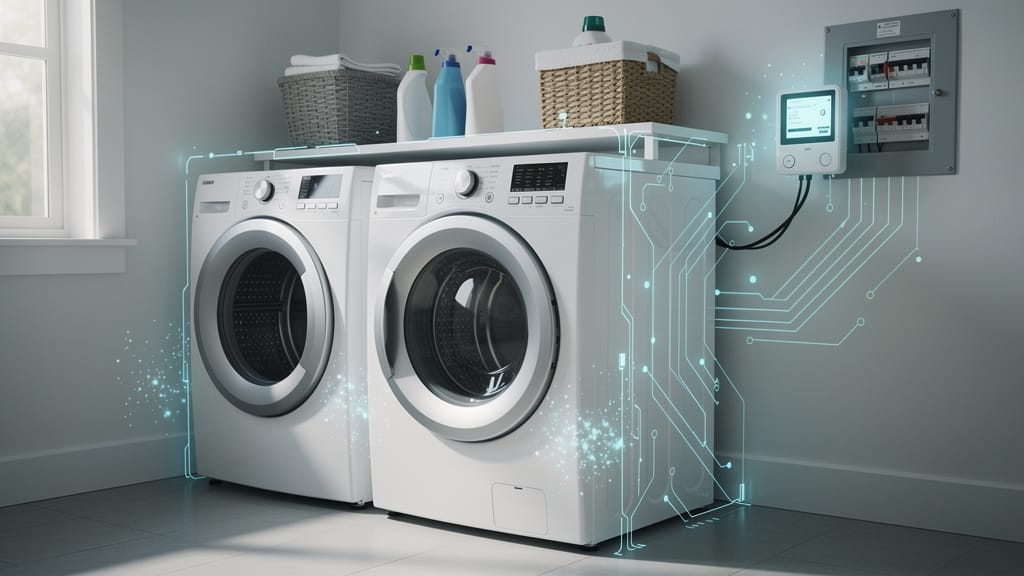
Circuit-level monitors close that gap in one of two ways. Some clip small sensors onto the individual circuit breakers inside an existing panel, giving a reading for each labeled circuit, kitchen, dryer, EV charger, directly in an app. Others use a different approach entirely: a single sensor on the main power line, paired with software that recognizes the unique electrical signature each appliance produces when it switches on. Over time, the system learns to recognize a refrigerator's compressor cycling, a well pump kicking on, or an air conditioner's startup surge, and reports on each one individually without needing a sensor on every circuit.
Either approach turns a single monthly number into a breakdown a homeowner can actually act on, whether that means noticing an old appliance is drawing far more than expected, catching a well pump that's cycling more often than it should, or simply seeing which habits are actually driving the bill up.
The Hardware Stack:
Sense Energy Monitor: A whole-home monitor that uses machine learning to identify individual appliances from a single sensor on the main electrical line.
Emporia Vue: A circuit-level monitor that uses clip-on sensors on individual breakers to report usage by labeled circuit.
Meross Smart Home Energy Monitor: An 18-circuit monitor offering local, subscription-free circuit tracking without a full panel replacement.
Presented by Porter & Co.
Trump’s secret money reset exposed
My name is Porter Stansberry.
I'm the founder of one of the largest independent financial research firms in the world. Over the last 30 years we've helped hundreds of thousands of Americans navigate almost every major economic cycle.
We've been on the forefront of every big financial story – from the collapse of Fannie Mae and Freddie Mac to the rise of Bitcoin, the COVID inflation surge, and the artificial intelligence revolution.
But today, I need to expose a story the likes of which we haven't seen in half a century.
In fact, the last – and only – time this happened was 1974. A secret deal struck in a Saudi desert that quietly determined the financial fate of an entire generation of Americans.
It created extraordinary wealth for some, while casting millions more into relative poverty.
Now, 52 years later, it's happening again.
And as you'll see, the aftershock of this event could reset not just your personal wealth, but the entire foundation of the U.S. dollar.
How you save, how you invest, how you protect everything you've built… it's all being reshaped by what Fortune calls "the biggest change to the world's relationship with the dollar" in a generation.
Yet almost nobody is prepared for it.
So if you've been watching the chaos of the past year unfold, struggling to make sense of it all – you're about to get the answers you've been searching for.
Everything from the government taking direct equity stakes in tiny mining companies… to Trump's obsession with Greenland… his strange deals with Elon Musk, Jeff Bezos, Sam Altman and Mark Zuckerberg… the re-opening of shuttered nuclear plants… and a $12 billion stockpile of obscure metals most Americans have never heard of…
It's all deeply and inexorably connected to an inescapable fact no-one has prepared you for:
Trump is replacing the dollar.
His shocking money reset has bypassed all conventional channels – enacted instead through a series of executive orders, bi-lateral deals and a landmark treaty signed by 13 nations in December 2025 (barely reported in the press) called Pax Silica.
You need to know that the financial decisions you make in the face of Trump's New Dollar could dictate whether you're enriched, or quietly impoverished by the seismic shift already underway.
The stocks to buy. The assets to avoid. And the critical moves our research indicates you should make to ensure you and your family end up on the right side of this once-in-a-generation wealth divide…
It's all laid out here for you in my important new briefing.
Good investing,
Porter Stansberry
Vulnerability Score
No appliance-level detail: A standard utility meter reports total usage only, with no way to isolate what a specific appliance or circuit is actually costing.
No early warning: Without circuit-level monitoring, a failing appliance that's drawing more power than it should typically goes unnoticed until it fails outright or the bill noticeably jumps.
No usage timeline: Without a monitoring app, there's no record of when in the day or month specific loads are running, which makes it harder to shift usage to cheaper off-peak hours.
What This Actually Changes Day to Day
None of these monitors reduce a home's electricity use on their own. What they do is turn an abstract monthly total into specific, actionable information, which is what actually leads to a lower bill, whether that's replacing an inefficient appliance, adjusting a thermostat schedule, or noticing a problem before it becomes an expensive one.
For a homeowner who's never seen a circuit-by-circuit breakdown of their own electricity use, it's often the single easiest place to start before considering a bigger investment like solar or battery storage.
840% Gains… and his next pick? (Sponsored by Awesomely)
What Do Trump, Buffett, and Bezos Know That We Don't? (Sponsored by Brownstone Research)