A home battery cannot go just anywhere. Building code sets a hard limit of 20 kWh per unit in a dwelling, caps what an indoor utility space can hold, and rules out bedrooms entirely. Most homeowners meet these rules for the first time when an installer says the spot they had in mind will not pass inspection.
What the Rules Actually Say
Two documents govern this. NFPA 855 is the fire standard for stationary energy storage, and Section R328 of the International Residential Code is what a local inspector for a one- or two-family home will usually be working from.
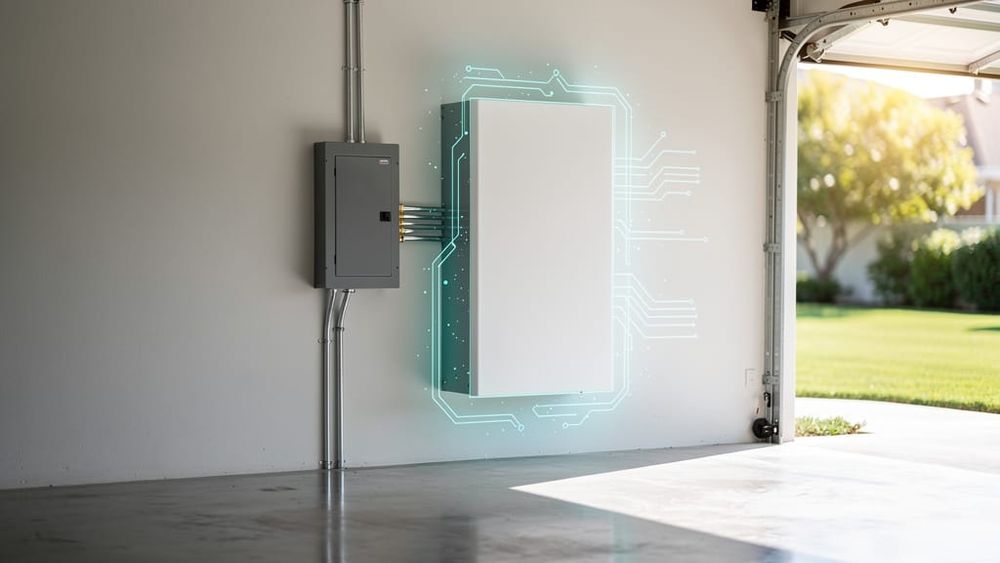
The numbers are specific. A single energy storage unit is limited to 20 kWh. An indoor utility space such as a closet, basement, or storage room can hold up to 40 kWh in total. An attached or detached garage, or a detached accessory structure, can hold up to 80 kWh. Units generally need about three feet of separation from each other, unless the manufacturer's UL 9540A fire testing demonstrates that a shorter distance is safe for that specific product.
Bedrooms are out, as are closets and spaces that open directly into a bedroom. The battery itself has to be listed and labeled to UL 9540, which is the safety standard for the complete system rather than the cells inside it.
That per-unit ceiling explains a lot about product design. A Tesla Powerwall 3 at 13.5 kWh and a FranklinWH aPower 2 at 13.6 kWh both sit comfortably below 20 kWh, and homeowners who want more capacity add units rather than buying one larger box.
NFPA 855 published a new edition this year, and the direction of travel is more testing rather than less. It adds explicit treatment of newer chemistries including iron-air, sodium sulfur, and zinc-air, makes a hazard mitigation analysis the default for nearly all installations, and requires large-scale fire testing showing that a fire in one unit will not spread to the unit beside it.
The Hardware Stack:
Tesla Powerwall 3: 13.5 kWh in a single wall-mounted unit, rated for indoor or outdoor installation and sized to stay under the per-unit limit.
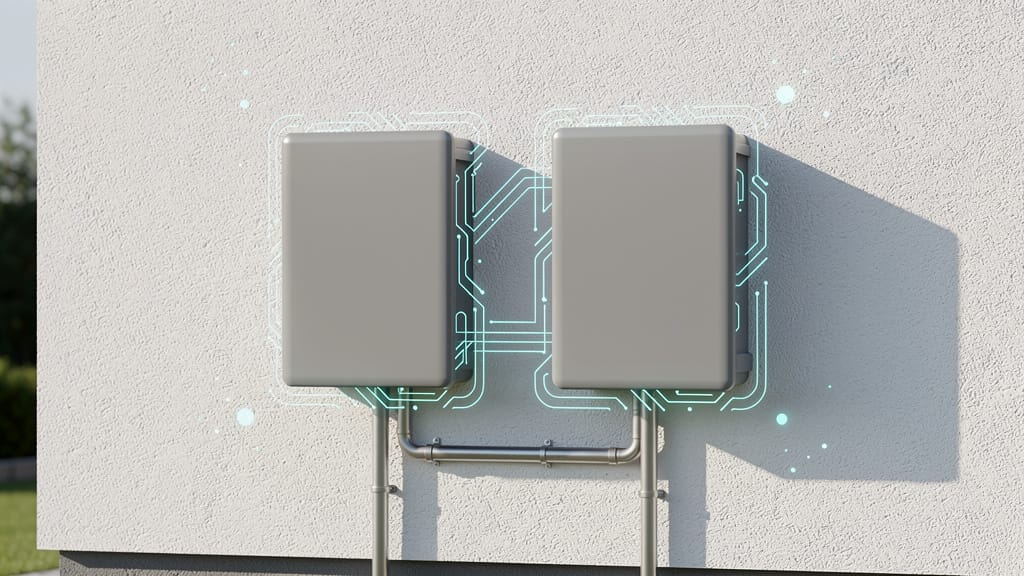
FranklinWH aPower 2: A 13.6 kWh LFP unit designed for garage or exterior wall mounting, commonly stacked in pairs for larger homes.
Enphase IQ Battery 5P: A roughly 5 kWh modular unit, useful where wall space or an aggregate cap makes one large box impractical.
Vulnerability Score
Failed inspection: A battery installed in a prohibited location or above the aggregate limit for that space will not pass, and moving one after mounting means new penetrations and new conduit runs.
Capacity ceiling: A home limited to an indoor utility closet is capped at 40 kWh, which sets a hard bound on how many days of backup it can hold regardless of budget.
Unlisted equipment: A system not listed to UL 9540 may be refused by the inspector, the utility, or the insurer, whatever its specifications claim.
Where This Lands for a Homeowner
None of this should read as a warning against home storage. These rules exist because energy storage is now common enough to have a mature code around it, which is a sign of a maturing product category rather than a risky one.
The practical takeaway is to settle the location question before the capacity question. Walk the house and identify where a unit can actually go: an exterior wall, the garage, a utility room that does not open into a bedroom. That location sets your aggregate ceiling, and the ceiling sets how much storage the conversation is really about. Doing it in that order avoids paying for a design that the inspector will not approve.
Written by Mason Vance