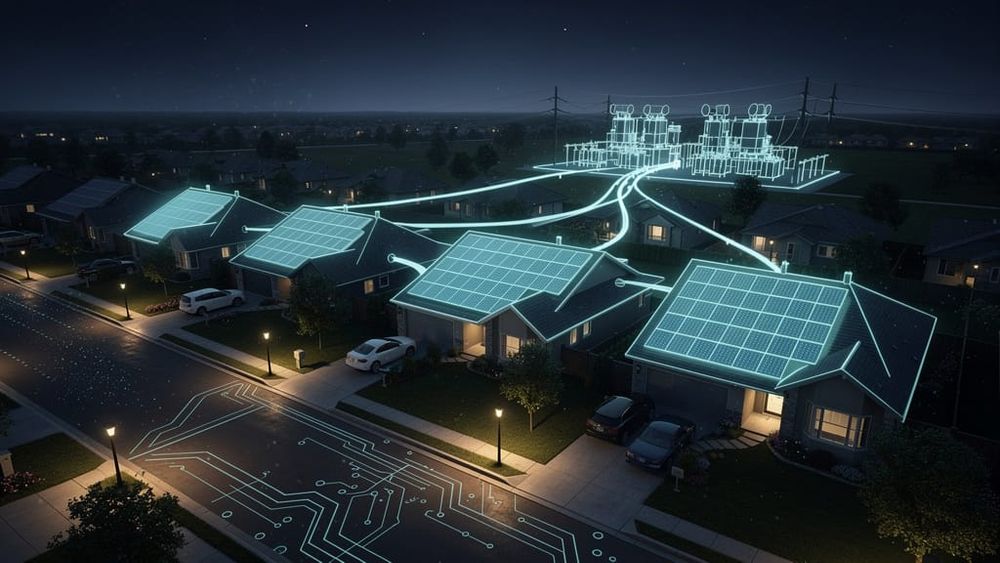
During the worst of this summer's heat waves, grid operators in several states asked data centers to switch to their own generators to free up capacity. At the same time, tens of thousands of home batteries were doing something similar in reverse, feeding stored power back into the grid for a few hours during peak demand, without their owners lifting a finger.
What a Virtual Power Plant Actually Is
A virtual power plant isn't a power plant in the traditional sense. It's a network of home batteries, all owned by individual households, that a utility or energy company can call on together during periods of high demand, the same way it might call on a natural gas plant. Instead of building new generation capacity for the handful of days a year when demand spikes, the grid borrows a small amount of stored energy from thousands of homes at once.
For a homeowner, participating usually just means enrolling an existing battery system through a manufacturer's app and agreeing to let a utility draw a portion of its stored power during declared emergency events, typically a handful of times a year, for a few hours at a time. The battery still prioritizes the home's own needs first, and enrollment is voluntary and can be adjusted or ended.
The scale of this has grown quickly. One California program built around residential batteries now coordinates well over 50,000 enrolled homes, and a separate agreement announced this year by Tesla, Sunrun, and Renew Home aims to aggregate more than 16 gigawatts of home batteries and smart thermostats, roughly comparable to the output of more than a dozen large power plants, without building a single one.
The Hardware Stack:
Tesla Powerwall: A widely enrolled home battery that participates in utility virtual power plant programs like Sunrun's CalReady and PG&E's emergency response program.
Enphase IQ Battery: A modular home battery system that's compatible with several regional virtual power plant enrollment programs.
SolarEdge Home Battery: Another compatible battery option for homeowners looking to enroll an existing solar-plus-storage system in a utility demand response program.
Presented by Porter & Co.
Porter’s explosive new documentary
I've been working with Porter Stansberry for over 20 years.
I was there when his warning about destruction of the dollar's purchasing power – The End of America – went viral…
And when he predicted that COVID-era money-printing would trigger the worst inflation in a generation.
But this might be the most explosive story he's ever broken – a bombshell monetary reset that nobody has told you about or prepared you for.
I’ll be sharing this video with my friends, my folks and everyone who’s financial future I care about.
If you have savings in the bank or any money in the market – you need to make time for this immediately.

In Porter’s new documentary, you'll discover:
How the last time America reset its money like this it created an average of 1,300 millionaires every day – while quietly ruining the wealth of millions more
Why you'll be forced to use this new money – whether you support it or not
How the most popular investments of the last decade could be among the worst bets of the new monetary order
Why most Americans will end up on the wrong side of this reset – and the one move that could determine which side you land on
Five assets Porter believes sit at the very heart of what's unfolding – and why a critical event in December could send them surging
Jared Kelly
CEO, Porter & Co.
Vulnerability Score
No enrollment: A home battery that isn't enrolled in any program only benefits its own household, even though the same hardware could also earn the owner a payment for supporting the wider grid.
No compatible hardware: Older battery systems, or systems without an internet-connected app, generally can't participate in virtual power plant programs at all.
No awareness of the trade-off: Some programs briefly reduce how much reserve a homeowner has during the exact hours a battery might otherwise be needed for a home outage, which is worth understanding before enrolling.
Planning Around the Pump, Not Just the House
None of this changes why most people buy a home battery in the first place, which is still primarily about their own bill and their own outage protection. But for someone who already has a compatible system sitting on the wall, enrolling it in a utility program is a way to get paid for capacity that would otherwise just sit in reserve most of the year.
It's worth checking whether an installed battery is eligible for a local program, since the enrollment process is usually quick, and the earnings, while modest, come from equipment the homeowner already paid for regardless.
You own these two timebombs — and can’t sell them (Sponsored by Porter & Co.)
The Energy Shock Is Here (Sponsored by Golden Portfolio)