
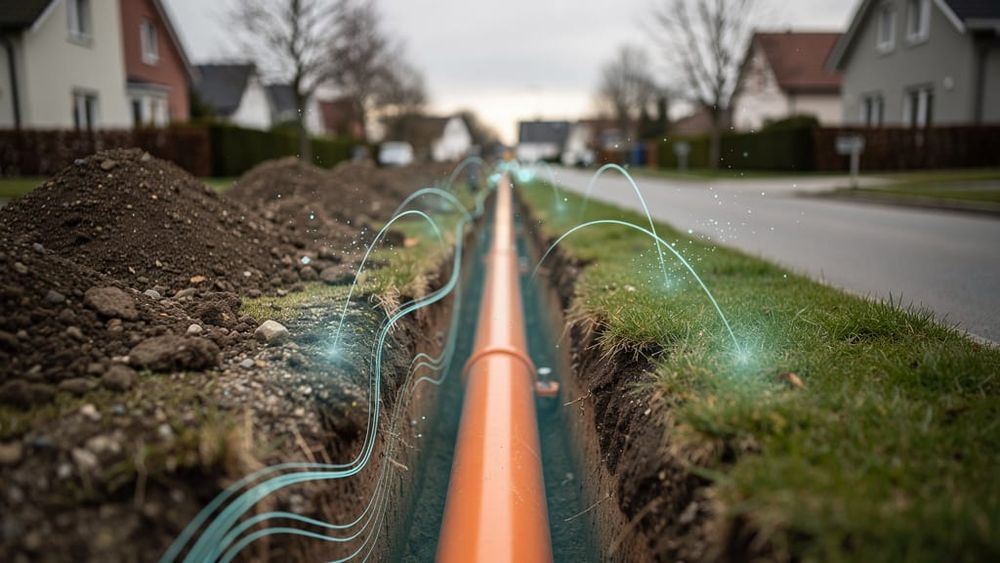
After every long outage, someone at the town meeting asks why the lines are not underground. It is a reasonable question with a specific answer, and the answer is a number per mile that explains why the conversation usually ends there.
The Number Per Mile
California regulators have put the cost of undergrounding distribution lines at roughly 350 to 1,150 dollars per foot, which works out to something between 1.85 and 6.07 million dollars a mile. The utility running the largest programme in the country reported averaging about four million dollars a mile when it started in 2021, around three million by 2023, and roughly 3.25 million over the last three years with a target near 2.8 million.
The money does not go into the cable. Civil work is seventy-five to ninety percent of the total: trenching, boring under driveways and roads, conduit, vaults, restoring pavement and landscaping. The electrical equipment is comparatively cheap. That is why the cost per mile varies so much between a new subdivision and an established street with mature trees and buried gas, water, and fibre already in the ground.
The scale puts it in perspective. The United States has roughly 5.5 million miles of distribution lines and more than 180 million poles, and the great majority of it is overhead. The underground share has moved slowly, from around eighteen percent in 2009 to roughly twenty percent by 2023. Where it does dominate, it is usually because of newer construction and local policy: Florida Power and Light reports about forty-five percent of its distribution system underground and about ninety percent of its new distribution going in underground.
The benefits are real. Buried lines are not exposed to wind, falling limbs, ice loading, or vehicle strikes, and the utility leading the California programme estimates a ninety-eight percent reduction in wildfire ignition risk on the circuits it has buried. It also reported hundreds of millions of dollars in avoided tree trimming and maintenance.
There is a trade-off people do not expect. When a buried cable does fail, finding the fault and repairing it takes substantially longer than replacing a crossarm. Undergrounding reduces how often outages happen and can lengthen the ones that do.
The Hardware Stack
Emporia Vue Energy Monitor: A panel monitor that logs outage start and end times, which is the record that turns an impression of unreliable service into evidence.
EcoFlow Delta Pro 3: A battery station for the hours the distribution system is going to keep delivering regardless of what the town decides.
Ting by Whisker Labs: Monitors the incoming service for the arcing and voltage signatures that precede a failure on the utility side.
Vulnerability Score
Rate recovery: Undergrounding is paid for through rates, so the question at the town meeting is not whether it is possible but who is being asked to fund it and over how many years.
Longer repairs: A buried fault takes longer to locate and fix, so the few outages that do occur can last longer than the overhead equivalent.
Project timelines: A single undergrounding project runs eighteen to twenty-four months from design to energisation, which is a different timescale from the storm that prompted the request.
What This Means for a Household
If your utility has an undergrounding programme, find out whether your circuit is on the list and where. These programmes are prioritised by wildfire risk and outage history rather than by request, and the published maps usually show the sequence several years out.
Understand that a customer-funded conversion of a single service drop is a different and much smaller project than converting a circuit, and it is sometimes available. It will not protect you from an outage further up the line, but it does remove the span over your own property from the equation.
Mostly, treat the answer as a planning input. Overhead distribution is going to be the normal case for most American homes for a long time, which makes the household-level questions the ones that actually move: which circuits you need during an outage, how long your utility's average restoration takes, and whether the trees along your own service drop have been trimmed recently.
Written by Mason Vance