There is a week in late November when American refrigerators are fuller than at any other point in the year. It is also the start of storm season in much of the country, which makes this the right moment to know the three numbers that decide what gets thrown away.
Four, Forty-Eight, Twenty-Four
With the door kept closed, a refrigerator holds food safely for about four hours. A full freezer holds for about forty-eight. A freezer that is only half full holds for about twenty-four.
Those figures assume the door stays shut, and that is the whole technique. Every opening costs cold air that will not be replaced. A household that treats the fridge as closed for the duration gets the full four hours; one that checks it every twenty minutes does not.
The thresholds behind the numbers are forty degrees Fahrenheit for the refrigerator and zero for the freezer. Those are the lines food safety guidance is written around, and the only way to know which side of them you are on is an appliance thermometer sitting in each compartment. They cost a few dollars and they convert a guess into a reading.
Refreezing is better understood than most people assume. Thawed food that still contains ice crystals, or that is at forty degrees or below, can be safely refrozen or cooked. Quality suffers, safety does not. What has to go is anything that thawed and sat warm.
The discard list for a refrigerator after four hours without cold is the perishable one: meat, poultry, fish, eggs, milk and cream, soft cheeses, cut fruit, cooked vegetables, leftovers, and anything with meat or egg in it. What survives is the shelf-stable end of the fridge: hard cheeses, butter, whole uncut fruit, peanut butter, jam, condiments and bread.
The rule that overrides all of the above is the simplest one. Never taste food to judge whether it is safe, because unsafe food can look and smell completely normal. When in doubt, throw it out.
The Hardware Stack
- Taylor Refrigerator Freezer Thermometer: A few dollars for the single device that turns this whole question from guesswork into a reading.
- EcoFlow Delta Pro 3: A battery station sized to run a refrigerator for a day or more, which is the appliance most worth backing up in this scenario.
- Govee Wi-Fi Fridge Thermometer: Logs and alerts remotely, which matters when the outage starts while the house is empty.
Vulnerability Score
The open door: Every check costs cold, and the instinct to look is strongest in exactly the first hours when the cold still matters.
Judging by smell: Appearance and odour are not a safety test, and the food most likely to cause illness gives no warning at all.
Half-empty freezer: The holding time halves, and most freezers in normal use are nearer half full than full.
What to Do Before the Storm
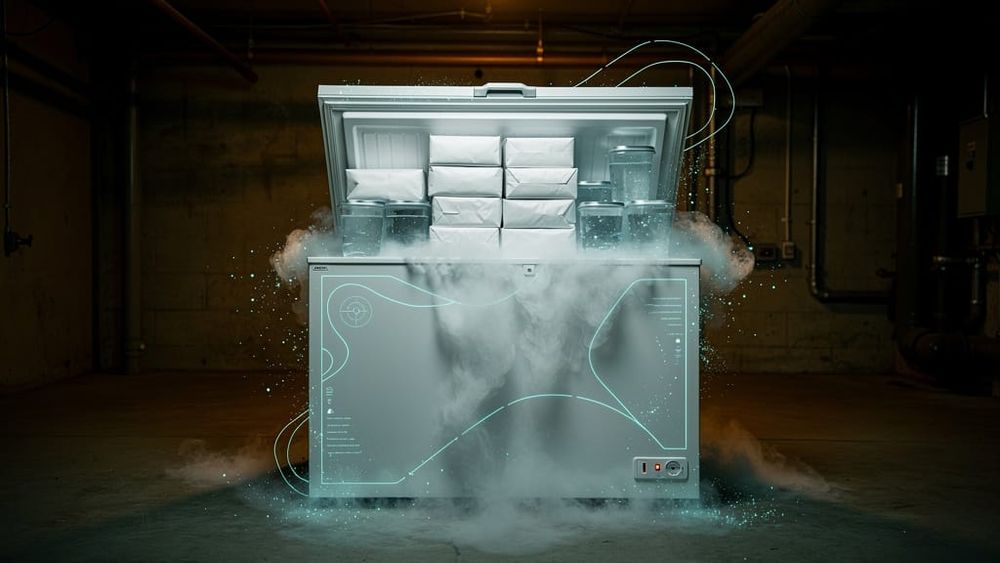
Fill the empty space. Containers of water frozen in the days before a forecast storm turn a half-full freezer into a full one, and they become the ice that keeps a cooler cold afterwards. It costs nothing and it doubles the holding time.
Put a thermometer in each compartment now. After the power returns, the question is not how long the outage lasted but what temperature the food actually reached, and only the thermometer answers it.
Have a cooler and frozen gel packs ready. The plan at the four hour mark is to move the perishables out of the refrigerator and into a cooler with ice, keeping them at forty degrees or below, rather than hoping the fridge holds longer than it does.
If the outage looks long, buy ice early. Block ice and dry ice both work, and one published example holds that fifty pounds of dry ice keeps an eighteen cubic foot full freezer cold for about two days. Handle dry ice with gloves and never in a sealed space.
And group the food together in the freezer. Items packed tightly hold their cold far longer than the same items spread across empty shelves.
Written by Mason Vance