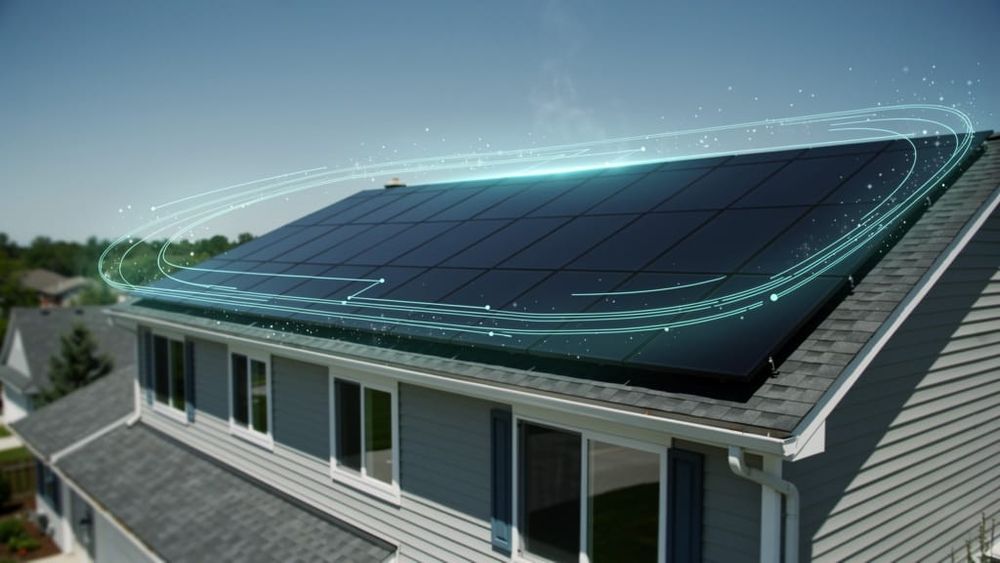
Read a solar proposal closely and you will often find that the panels add up to more kilowatts than the inverter is rated for. That looks like a mistake, or like someone undersized a component to save money. It is neither. It is the standard way these systems are designed, and the reasoning is worth understanding because it affects what you should expect on a bright day.
The Ratio and What It Buys
The relationship has a name: the DC to AC ratio, also called the inverter loading ratio. It is the array's rated DC capacity divided by the inverter's AC rating. A ten kilowatt array on an eight kilowatt inverter is a ratio of 1.25.
The reason to oversize is that panels almost never produce their rated output. The nameplate is measured under standard test conditions that correspond to a bright, cool, perfectly aimed moment. Real arrays spend most of the day well below that, held down by sun angle, temperature, haze, and orientation. An inverter sized exactly to the nameplate therefore spends almost all of its life loafing.
Adding panels fills in the shoulders of the day. Mornings and late afternoons produce more, cloudy days produce more, and the inverter does useful work for more hours. US data puts typical residential loading ratios somewhere between about 1.13 and 1.30, with values around 1.25 often described as the sweet spot.
The cost is clipping. On the brightest hours of the best days, the array can produce more than the inverter can pass, and the surplus is simply not harvested. The inverter holds its output flat at its rating, which is where the characteristic flat-topped production curve comes from.
The amount lost is smaller than the flat top makes it look. Modelling on one example system put clipping losses under one percent of annual output at a ratio of 1.3, rising to roughly five percent at 1.5. Up to a point the extra panels add far more energy than clipping takes away.
Two things change the calculation. A battery can absorb some of what would otherwise clip, if the system is DC coupled. And microinverters move the question to each panel individually, so the ratio is set by the pairing of module to microinverter rather than across the whole array.
The Hardware Stack:
Enphase IQ8 Microinverters: Sets the loading ratio per module, which is why module choice and microinverter model have to be matched at design time.
SolarEdge Home Hub Inverter: A string hybrid, where the DC to AC ratio is a system-level decision and a DC-coupled battery can capture part of the clipped energy.
Tesla Powerwall 3: Integrates the solar inverter, which makes the array-to-inverter ratio and the battery sizing a single decision rather than two.
Vulnerability Score
Misread production curve: A flat top on a sunny day looks like a fault to an owner watching the app, and it is usually normal design behaviour instead.
Over-oversizing: Ratios pushed well past the usual range do start losing meaningful energy, and the extra panels are paid for whether or not their output is harvested.
Expansion limits: An array already at a high ratio has little room for more modules later without replacing the inverter, which matters if an EV or a heat pump is coming.
What to Ask and What to Watch
Ask the installer for the DC to AC ratio of the proposed design, and ask what modelled clipping loss it implies for your site. A designer who has the number at hand has done the analysis; one who treats the question as unusual probably has not.
Then watch your own production curve on the first clear summer day. A smooth arc means the inverter is never reaching its limit, which is fine but suggests room for more panels. A flat top for an hour or two at midday is the design working as intended. A flat top lasting most of the day is the one worth asking about, because that is where the ratio has gone further than the arithmetic supports.
Written by Mason Vance