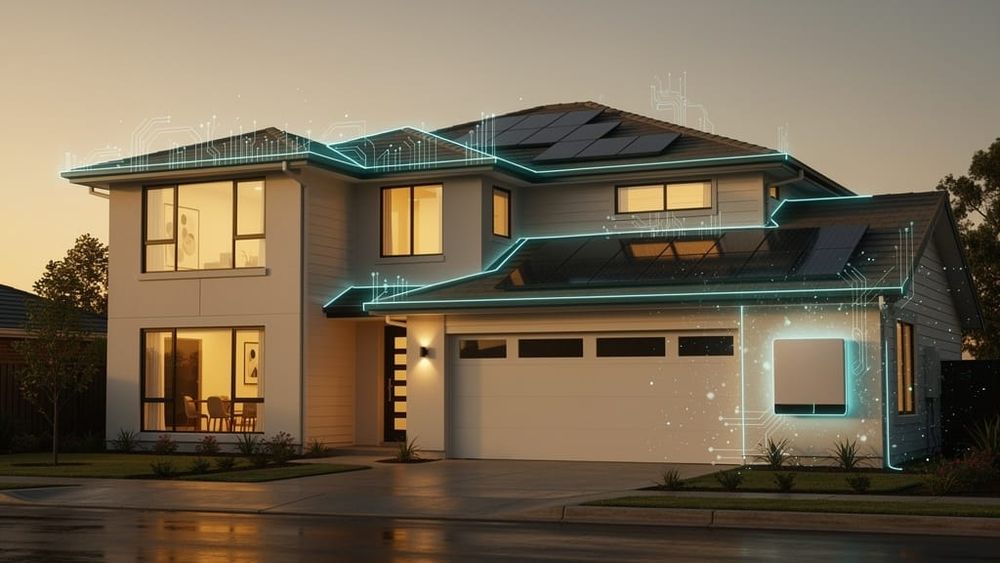
A few years ago, most homeowners installed solar panels first and thought about a battery later, if at all. That's no longer the default. Nationally, close to half of new residential solar installations now include a battery as part of the original system, up sharply from just a year earlier, according to industry tracking from the American Clean Power Association.
Solar Is Becoming a System, Not Just Panels
For most of the last decade, solar quotes were built around one question: how many panels does this roof need? Storage was the upsell, something a homeowner might add after living with an outage or two. That order has started to reverse.
Part of the shift is financial. Batteries used to add a large amount to the cost of a solar system for a benefit most people only noticed a few times a year, during an outage. Battery prices have come down enough, and utility rate structures have changed enough in many states, that a battery can now shift when a home draws from the grid versus its own panels, lowering the electric bill directly rather than just sitting in reserve. Reducing the monthly bill, not just outage protection, is now the top reason homeowners give for adding one.
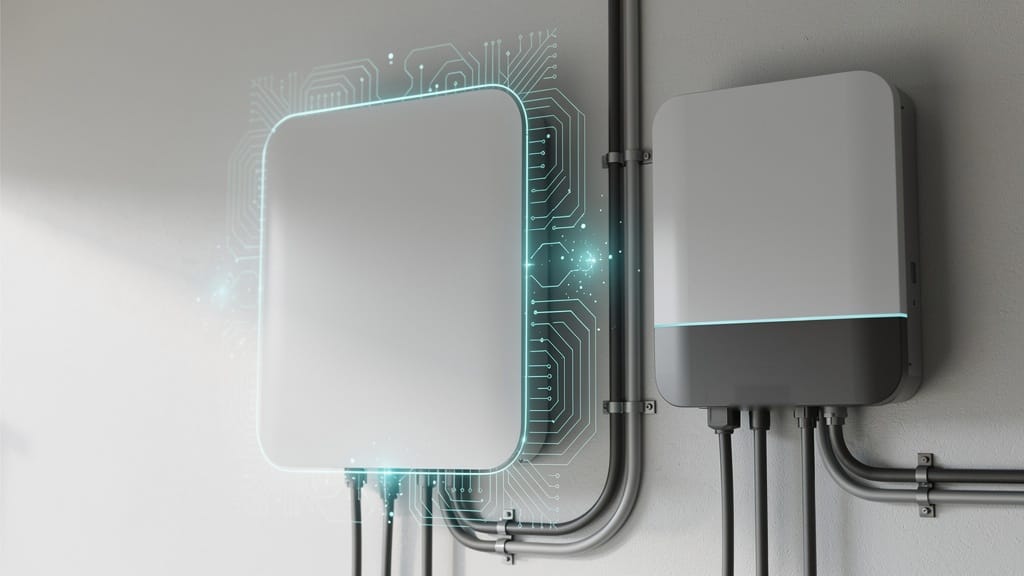
The other part is simply how the systems work together now. Modern solar-plus-storage setups use an inverter that manages the flow between the panels, the battery, and the home in real time, deciding automatically whether to charge the battery, send power to the house, or export excess to the grid depending on the time of day and the utility's rate schedule. That coordination is what makes a battery pay for itself faster than it used to, rather than just providing backup.
The Hardware Stack:
Tesla Powerwall 3: An all-in-one battery with a built-in solar inverter, commonly installed alongside new panels in a single combined system.
Enphase IQ Battery 5P: A modular battery that pairs with Enphase's microinverters, letting homeowners add capacity in stages as needs grow.
SolarEdge Home Battery: A DC-coupled battery built to work directly with SolarEdge's inverter, reducing energy loss between the panels and storage.
Presented by Energy Exploration Technologies
You Can't Buy Anthropic. You Can't Buy OpenAI. You Have Until July 16 to Buy This.
If those two companies reach public markets, a similar story to SpaceX's $1.75T IPO will likely play out: “company goes public after its biggest growth has already occurred at the private stage.”
But there's a private company with a valuation north of $1B that’s still preparing for its biggest growth opportunities. Meet EnergyX, a company backed by General Motors, POSCO, and Eni that's open to you right now.
Their patented lithium technology can recover up to 3X more than traditional methods, 500X faster. Lithium demand is projected to grow 5X by 2040, In total, EnergyX’s project portfolio spans nearly 150,000 acres with up to 15M+ tons of untapped lithium.
Over 50,000 investors have already put in more than $180M. Become an early-stage EnergyX investor by the July 16 deadline.
Vulnerability Score
No battery: Solar panels stop producing usable power for the home the moment the grid goes down, since most standard inverters shut off automatically during an outage as a safety measure.
No time-of-use awareness: Without a battery managing when power is drawn from the grid versus the panels, a home gets no benefit from rate schedules that charge less at certain hours.
No staged capacity: A single fixed battery size can't be added to later, unlike modular systems, which means the original sizing decision has to account for future needs.
What This Means for Homeowners Weighing the Decision
None of this means every home needs a battery, and plenty of people are still well served by solar alone if their main goal is lowering summer bills rather than outage protection. But the calculation has shifted. What was once a backup feature considered mainly for peace of mind is increasingly just part of how a solar system pays for itself, month to month, regardless of whether the power ever goes out.
For someone evaluating a quote today, the more useful question isn't whether to add a battery someday, but whether the system being proposed is actually designed to work as one, with the inverter, panels, and storage coordinating from the start rather than bolted together after the fact.
Billionaires Pulling Back? Not the Way You Think... (Sponsored by Brownstone Research)
The U.S. Just Bought $15 Billion of Its Own Debt (Sponsored by Golden Portfolio)
Trump’s One Rule exposed: Executive Order 14179 (Sponsored by Porter & Co.)
What 60 companies just admitted under penalty of perjury (Sponsored by Porter & Co.)
Disclaimer
Energy Exploration Technologies, Inc. (“EnergyX”) has engaged Genius Marketing to publish this communication in connection with EnergyX’s ongoing Regulation A offering. Genius Marketing has been paid in cash and may receive additional compensation. Genius Marketing and/or its affiliates do not currently hold securities of EnergyX. This compensation and any current or future ownership interest could create a conflict of interest. Please consider this disclosure alongside EnergyX’s offering materials. EnergyX’s Regulation A offering has been qualified by the SEC. Offers and sales may be made only by means of the qualified offering circular. Before investing, carefully review the offering circular, including the risk factors. The offering circular is available at invest.energyx.com. Comparisons to other companies are for informational purposes only and should not imply similar results.