A home battery that performs beautifully in a mild climate can lose a meaningful chunk of its usable capacity once temperatures drop well below freezing. For homeowners in genuinely cold regions, that gap has quietly shaped which battery chemistry actually makes sense.
What Cold Actually Does Inside a Battery
Nearly every home battery on the market today uses some form of lithium-ion chemistry, and lithium batteries share a common weakness: cold slows down the chemical reaction that moves charge through the battery. At moderately cool temperatures the effect is minor, but in genuinely cold conditions, well below freezing, both charging speed and usable capacity can drop noticeably, and charging a lithium battery too aggressively in the cold can permanently damage it.
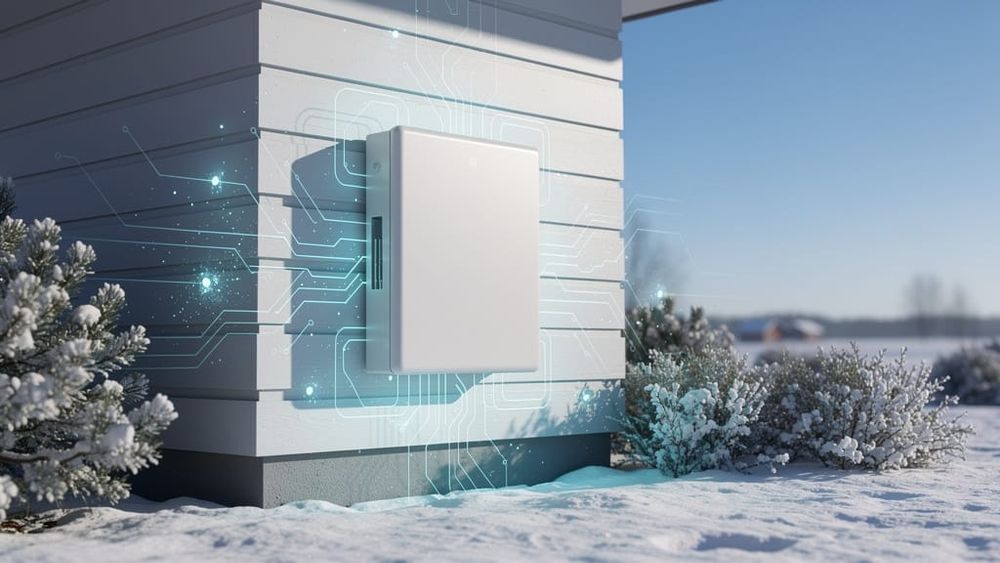
Manufacturers have mostly solved this with internal heating elements that warm the battery before it charges in cold weather. It works, but it costs energy, sometimes called a heating tax, since power that could go toward the home instead goes toward keeping the battery at a safe operating temperature.
A different battery chemistry, sodium-ion, handles cold differently by nature rather than by compensating for it. Sodium-ion batteries remain stable across a much wider temperature range without needing the same internal heating, and they charge faster in cold conditions than a comparable lithium battery. The trade-off is that sodium-ion currently stores less energy for the same physical size than lithium-ion, so a sodium battery system is somewhat larger for the same usable capacity.
For most homeowners in moderate climates, that trade-off doesn't matter enough to switch. For someone installing a battery in a region that regularly sees hard freezes, it's a real enough difference that it's now a legitimate factor in the decision, not just a chemistry detail for engineers to argue about.
The Hardware Stack:
UNIGRID Na+Casa: A wall-mountable sodium-ion residential battery system built specifically to perform reliably in cold-climate installations.
Tesla Powerwall 3: A lithium-ion battery representing the current mainstream standard, which relies on internal heating to maintain performance in cold weather.
Enphase IQ Battery 5P: A modular lithium-ion system offering another point of comparison for capacity and cold-weather behavior against newer sodium-ion options.
Presented by Porter & Co.
I've been working with Porter Stansberry for over 20 years.
I was there when his warning about destruction of the dollar's purchasing power – The End of America – went viral…
And when he predicted that COVID-era money-printing would trigger the worst inflation in a generation.
But this might be the most explosive story he's ever broken – a bombshell monetary reset that nobody has told you about or prepared you for.
I’ll be sharing this video with my friends, my folks and everyone who’s financial future I care about.
If you have savings in the bank or any money in the market – you need to make time for this immediately.

In Porter’s new documentary, you'll discover:
- How the last time America reset its money like this it created an average of 1,300 millionaires every day – while quietly ruining the wealth of millions more
- Why you'll be forced to use this new money – whether you support it or not
- How the most popular investments of the last decade could be among the worst bets of the new monetary order
- Why most Americans will end up on the wrong side of this reset – and the one move that could determine which side you land on
- Five assets Porter believes sit at the very heart of what's unfolding – and why a critical event in December could send them surging
Jared Kelly
CEO, Porter & Co..
Vulnerability Score
No cold-weather rating: A battery without documented cold-temperature performance data may charge more slowly, or lose usable capacity, exactly during the winter storms when backup power matters most.
No internal heating: An older or budget lithium battery without a heating system built in can be damaged by charging in genuinely cold conditions, rather than simply underperforming.
No regional context: A battery's marketed capacity is typically measured at a comfortable reference temperature, which may not reflect what it actually delivers during a hard freeze.
Choosing a Battery With the Local Climate in Mind
None of this makes lithium-ion the wrong choice for most homes, it remains the dominant, well-proven option almost everywhere. But for a homeowner in a genuinely cold climate, it's worth asking an installer directly how a specific battery performs at the coldest temperatures the region actually sees, rather than relying on a spec sheet measured somewhere warmer.
Sodium-ion home batteries are still new to the US market, with wider availability expected as compliance testing wraps up, but the underlying idea, matching battery chemistry to actual climate, is worth understanding now regardless of which specific product a homeowner ends up choosing.
I found the smoking gun (Sponsored by Brownstone Research)
1,000-year financial link just shattered (Sponsored by Porter & Co.)
The US sanctioned itself out of world reserve status… (Sponsored by Golden Portfolio)
You own these two timebombs — and can’t sell them (Sponsored by Porter & Co.)