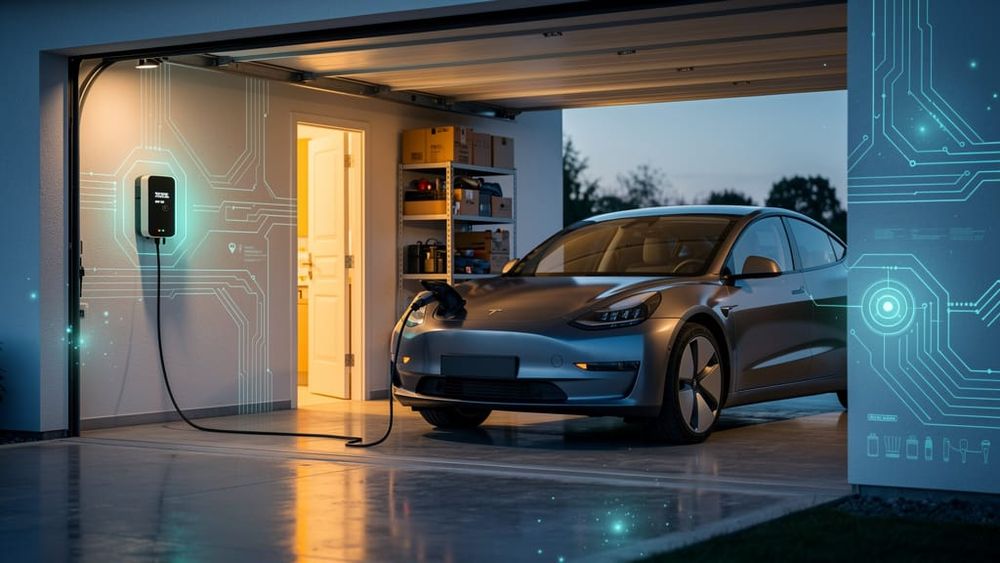
Vehicle-to-home charging used to be a feature limited to one or two headline EV models. General Motors is taking a different approach, building the capability into nearly its entire electric lineup rather than treating it as a premium extra reserved for a flagship truck.
Sponsored by Freedom Financial Research
While Elon tweets about UBI, these investors collect 10% a year
Editor’s Note: Robert Kiyosaki, author of Rich Dad Poor Dad, the #1 personal finance book of all time with over 40 million copies sold, has spent decades teaching everyday Americans how the wealthy actually build income. He called the 2008 housing crash before it happened, warned investors to buy gold and silver well before their historic runs, and has been pounding the table on cash-flowing assets for over 30 years. Today, he’ll show you an income play funded entirely by America’s oil and gas infrastructure — one that’s already paying some investors $25,000 a month and is the closest thing to universal basic income that may ever exist. Click here to see the details or read more below.
Dear Reader,
Elon Musk has been tweeting about universal basic income for almost a decade.
“There will be universal high income,” he told a Paris tech conference in 2024.
Last December he posted: “There will be no poverty in the future. No need to save money.”
Easy to say when you’re the richest man on the planet.
But Musk isn’t wrong. He’s just early.
Someday, AI might make guaranteed income possible — whether it’s $500 a month or $4,000. But that could be 20 years away.
So while you wait for AI to deliver your government check — which may be 20 years from now — I want to show you something that actually exists today.
I call it the Patriot Income Plan, or P.I.P. for short.
It’s funded entirely by America’s oil and gas infrastructure, and it pays 10% a year, 42 separate payments a year, to everyone who owns units.
One investor collects $4,800 a month. Another, $4,200 a month. I even found one investor pulling in over $25,000 a month.
Elon can wait for the robots. You don’t have to.
The next P.I.P. payout is days away.
Enrollment is easy.
Sincerely,
Robert Kiyosaki
Editor, The Kiyosaki Letter
Bidirectional Charging Becomes the Default, Not the Exception
GM has committed to expanding vehicle-to-home, or V2H, bidirectional charging across its Ultium-based electric vehicle lineup, with the goal of having nearly every new GM EV support it by the end of model year 2026. The Chevrolet Equinox EV, GMC Sierra EV, and Cadillac Lyriq already offer the capability, putting bidirectional charging within reach of a much wider range of price points than the segment has typically offered.
The underlying idea is the same one that made the Ford F-150 Lightning notable when it launched with V2H as a standard feature: an EV's battery, which is often significantly larger than a dedicated home battery, can power a house during an outage in addition to its normal job of moving the car. Where GM's approach differs is scale, rather than a single flagship vehicle, the intent is to make the feature a standard part of buying nearly any new GM EV, from a compact crossover to a full-size truck.
This isn't free, the hardware required, typically a dedicated bidirectional charger and, often, a compatible home electrical setup, adds real cost, and GM's rollout has moved slower than originally announced. But as more manufacturers, including Ford, Kia, and Hyundai, treat V2H as a mainstream feature rather than a novelty, the practical calculation for EV owners is starting to shift: a bidirectional-capable EV increasingly overlaps with what a dedicated home battery is for, at least during the hours the car happens to be parked at home.
The Hardware Stack:
Chevrolet Equinox EV: A mainstream-priced GM electric vehicle now offering vehicle-to-home bidirectional charging capability.
GM Energy bidirectional charger: The dedicated home hardware required to actually use a compatible GM EV's battery to power a house.
Ford Charge Station Pro: A competing bidirectional charging system used with the Ford F-150 Lightning, offered as a comparison point for how mainstream the feature has become across manufacturers.
Vulnerability Score
No bidirectional hardware: Owning a V2H-capable EV without the required dedicated charger and home setup means the capability exists in the vehicle but isn't actually usable during an outage.
No home electrical compatibility check: Some homes need panel or wiring updates to safely support bidirectional charging, a step easy to overlook when focused on the vehicle purchase itself.
Assuming the car is always available: An EV parked at work or away from home during an outage provides none of its backup potential, unlike a stationary home battery that's always present.
What This Means for Anyone Cross-Shopping an EV and a Battery
For a household already planning to buy an EV, checking whether a specific model and trim supports V2H, and what the bidirectional charging hardware actually costs, is now a reasonable part of that research, not a niche consideration. It could meaningfully change whether a separate home battery purchase is still necessary, or whether it becomes a smaller, supplemental piece of a broader backup plan.
For anyone not planning to buy an EV soon regardless, this trend is still worth watching, since it signals how quickly the line between "electric vehicle" and "home battery" is blurring across the industry, not just at one manufacturer.
Written by Mason Vance
The Next Commodity Crunch (bigger than oil?) (Sponsored by Awesomely)
This 50-year dollar agreement just ended quietly… (Sponsored by Golden Portfolio)
It’s growing faster than Tesla and SpaceX (Sponsored by Brownstone Research)
This could be bigger than Tesla and SpaceX combined (Sponsored by Brownstone Research)