
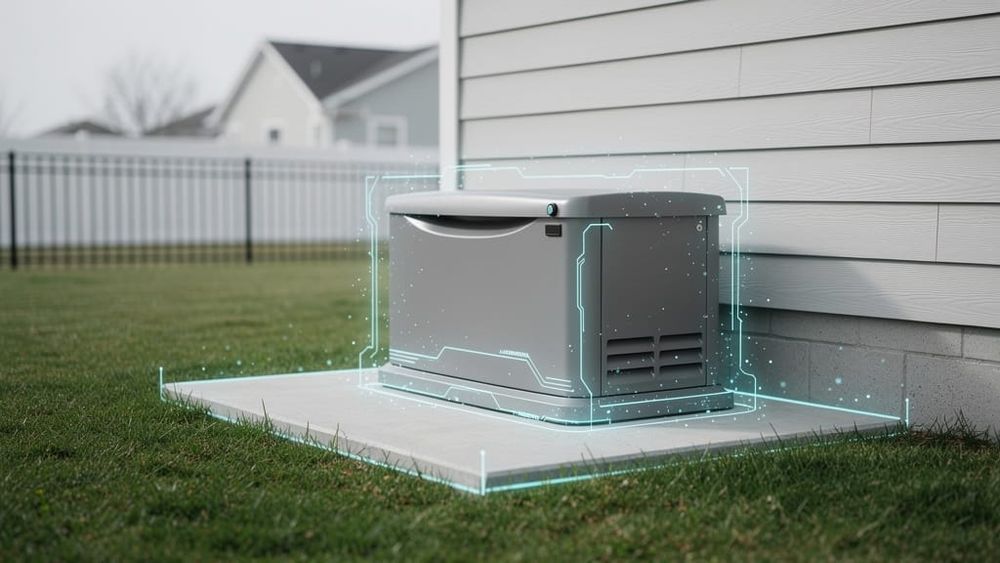
The obvious place to put a standby generator is the narrow side yard, out of sight, close to the gas meter and the panel. That is also the one spot that most often turns out to be unusable, and the reasons are a stack of separate rules that each apply on their own.
Sponsored by StocksToTrade.com
Did Elon just confirm the plan?
Dear Reader,
Everyone wants to know what Elon Musk is planning next.
I believe this is it – what I’m calling, “Mission X.”
Elon’s bold new plan to ship AI off the Earth entirely – and launch it into the stars.
He confirmed it himself:
“I see a path to SpaceX being worth orders of magnitude more than the current Earth economy.”
— Elon Musk
Because I promise you, he’s not just talking about launching rockets.
It’s why I’ve just released all the details of “Mission X” – including a FREE ticker to get positioned at practically the ground floor – without buying SpaceX or Tesla.
Click Here to Watch — 100% Free. No Credit Card Required.
Best,
Tim Bohen
P.S. Billionaire Peter Thiel once said: “I would never bet against Elon, in anything. That’s hard rule number one.”
The skeptics are lining up again. But you don’t have to miss out.
REVEALED: Free Ticker to Claim Your Stake in “Musk’s Mission X.”
Four Rules That Have to Be Satisfied at Once
The first comes from the manufacturer, and it is about exhaust. A standby unit must sit a minimum distance from any openable window, door, or vent, commonly five feet, so that exhaust does not find its way indoors. Eaves and soffit vents overhead count, which rules out tucking a unit tight under the roofline.
The second is clearance for air and for people. Manufacturers specify a gap behind the unit, often around eighteen inches to the wall, and a working space in front, usually about three feet, so a technician can open the enclosure and service it. Shrubs, fence panels, and firewood stacked against the sides all defeat the cooling airflow the unit depends on.
The third is zoning, and it is entirely local. Setbacks from side and rear property lines for mechanical equipment commonly run anywhere from three to ten feet depending on the district, and some municipalities treat a generator as an accessory structure with its own rules. If propane is the fuel, the tank carries separate distance requirements from both the building and the line, often ten feet for a five hundred gallon tank, and those usually govern the layout more than the generator does.
The fourth is noise, and it is the one that produces neighbour disputes rather than code violations. An air-cooled residential unit runs somewhere around sixty-five to seventy decibels measured at about twenty feet, which is conversational but constant. Many municipalities have a residential noise limit measured at the property line, and a weekly exercise cycle scheduled for eight in the morning on a Saturday is a reliable way to find out what yours is.
When these conflict, the strictest applies. A unit can satisfy the manufacturer and still fail zoning, or pass both and still be a problem for the house next door.
The Hardware Stack:
Generac Guardian Series: A common air-cooled residential platform whose installation manual states the required clearances to openings, walls, and overhead obstructions.
Kohler Home Generator: An alternative line, relevant because published sound levels and required clearances differ between manufacturers.
Briggs and Stratton Standby Generator: Another option, where enclosure design and exhaust direction change which side of a house it suits.
Vulnerability Score
Stacked rules: A location can satisfy the manufacturer and fail zoning, or satisfy both and violate a noise limit, so passing one check proves little.
Airflow starvation: Fences, shrubs, and stored materials around a unit restrict the cooling air it needs, which shortens its life and can cause it to shut down under load.
Fuel geometry: A propane tank's own setbacks are often the binding constraint, and discovering that after choosing the generator's spot means redoing the layout.
Settling It Before the Quote
Walk the perimeter and mark every openable window, door, dryer vent, and soffit vent. Then look at what remains with the clearances in mind, and you will usually find there are only one or two candidate locations rather than the whole yard.
Before signing, call the building department and ask two specific questions: what the setback is for mechanical equipment in your zoning district, and whether a residential noise limit applies at the property line. Both answers are free, both take one phone call, and either one can move a generator to the other side of the house. It is far better to learn that now than after the pad has been poured.
Written by Mason Vance
Any discussion of securities, assets, or financial markets in this email is for informational context only and does not represent investment guidance of any kind.