An EV battery is typically five to ten times larger than a home battery like a Tesla Powerwall. For years that extra capacity just sat there during an outage, unusable by the house it was parked next to. In 2026, a growing number of vehicles can now send that power the other direction, into the home itself.
How a Car Becomes a Home Battery
The technology is called vehicle-to-home, or V2H, and it works by reversing the normal flow of a charging session. Instead of only pulling power from the grid into the car, a bidirectional charger can also pull power out of the car's battery and feed it into the house through the electrical panel, the same way a whole-home battery would.
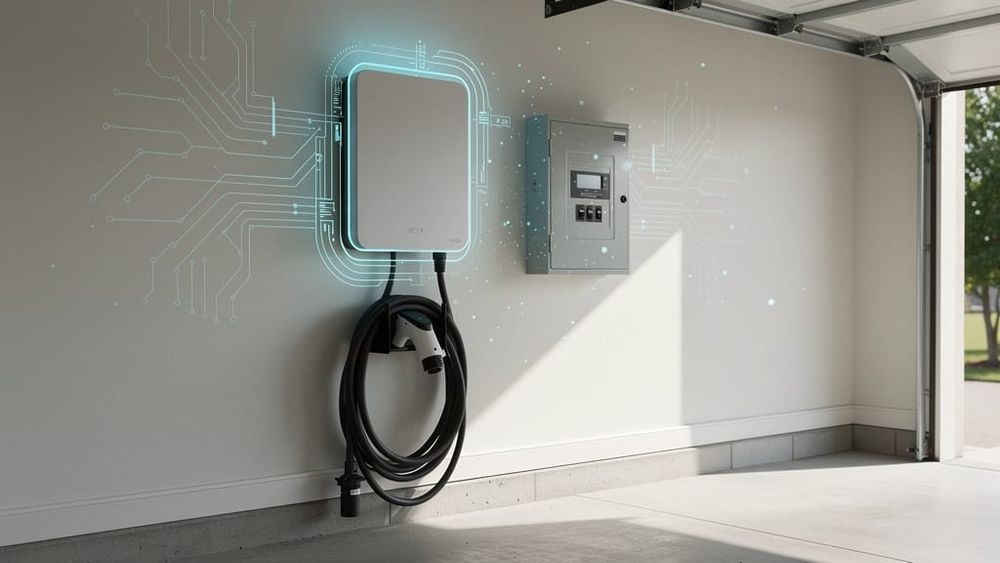
This requires specific hardware on both ends. The vehicle needs a battery and onboard system built to support two-way power flow, which as of this year is available on a growing list of trucks and SUVs from GM, Ford, and other manufacturers. The home needs a bidirectional charger and a transfer switch capable of isolating the house from the grid during an outage, similar in concept to what a standby generator setup requires.
What makes this notable isn't just the capability, it's the scale. A large EV battery can be big enough to power an average home for several days on a single charge, far beyond what most standalone home batteries are sized for. For a household that already owns a compatible EV, that's a substantial amount of backup capacity that exists whether or not they ever planned to buy a home battery separately.
The Hardware Stack:
Wallbox Quasar 2: A bidirectional charger and power recovery unit that lets a compatible EV supply backup power to an entire home during an outage.
Ford F-150 Lightning: A truck offering Intelligent Backup Power, one of the earliest widely available V2H systems paired with Ford's Charge Station Pro.
GM Silverado EV: A large-battery electric truck built on GM's Ultium platform with vehicle-to-home capability across its lineup.
Presented by Porter & Co.
Porter’s explosive new documentary
I've been working with Porter Stansberry for over 20 years.
I was there when his warning about destruction of the dollar's purchasing power – The End of America – went viral…
And when he predicted that COVID-era money-printing would trigger the worst inflation in a generation.
But this might be the most explosive story he's ever broken – a bombshell monetary reset that nobody has told you about or prepared you for.
I’ll be sharing this video with my friends, my folks and everyone who’s financial future I care about.
If you have savings in the bank or any money in the market – you need to make time for this immediately.

In Porter’s new documentary, you'll discover:
- How the last time America reset its money like this it created an average of 1,300 millionaires every day – while quietly ruining the wealth of millions more
- Why you'll be forced to use this new money – whether you support it or not
- How the most popular investments of the last decade could be among the worst bets of the new monetary order
- Why most Americans will end up on the wrong side of this reset – and the one move that could determine which side you land on
- Five assets Porter believes sit at the very heart of what's unfolding – and why a critical event in December could send them surging
Watch it here now.
Jared Kelly
Vulnerability Score
No bidirectional hardware: A standard Level 2 charger can only send power into the car, so even a compatible EV can't supply the house without the right charger and transfer switch installed.
No panel headroom: Many homes built before 2010 need an electrical panel upgrade to support the higher-amperage circuit a bidirectional charger requires.
No isolation switch: Without a transfer switch, a home can't safely disconnect from the grid to run on the car's battery during an outage, which is a safety requirement, not an optional feature.
What This Means for Someone Who Already Owns a Compatible EV
None of this makes buying an EV specifically for backup power the right call for most households, the vehicle itself is still the primary purchase decision. But for someone who already owns, or is already planning to buy, a truck or SUV with V2H support, the backup power case becomes a genuine bonus rather than a separate expense.
The practical question is whether the added cost of a bidirectional charger and any needed panel work is worth it compared to a standalone home battery, and for a household with a compatible vehicle already in the driveway, that math often looks better than starting from zero.
The U.S. Just Bought $15 Billion of Its Own Debt (Sponsored by Golden Portfolio)
New Patent Reveals Elon Musk's Next Breakthrough: M.A.G.I. (Sponsored by Brownstone Research)
It’s growing faster than Tesla and SpaceX (Sponsored by Brownstone Research)
In 2017, I told my father to buy Nvidia. Today, I’d tell him to buy THIS (Sponsored by Omnia Research)