
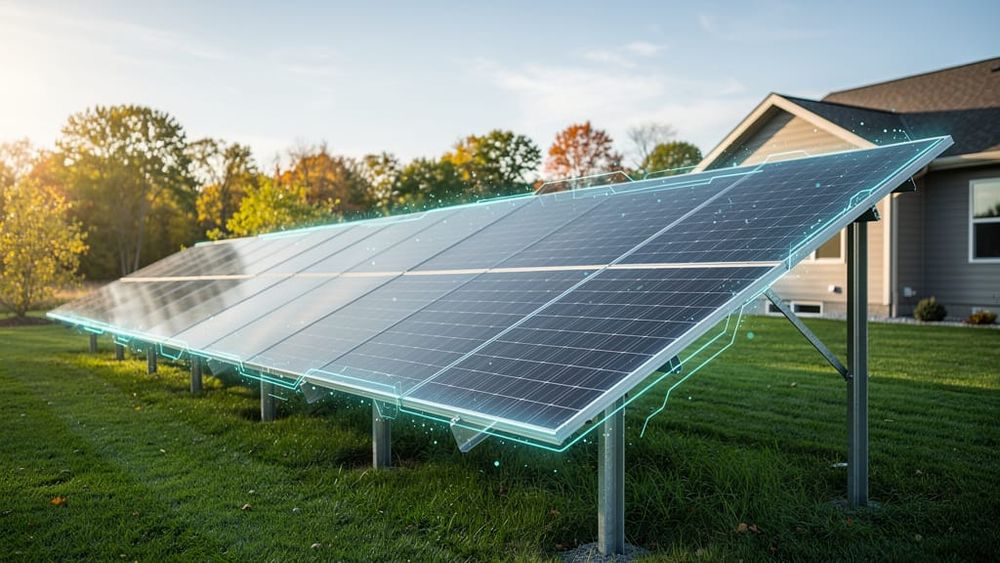
Most residential solar goes on the roof because the roof is already there. When a property has open land, the alternative is worth a serious look, because almost every variable changes at once and several of them change in the homeowner's favour.
The Trade in Both Directions
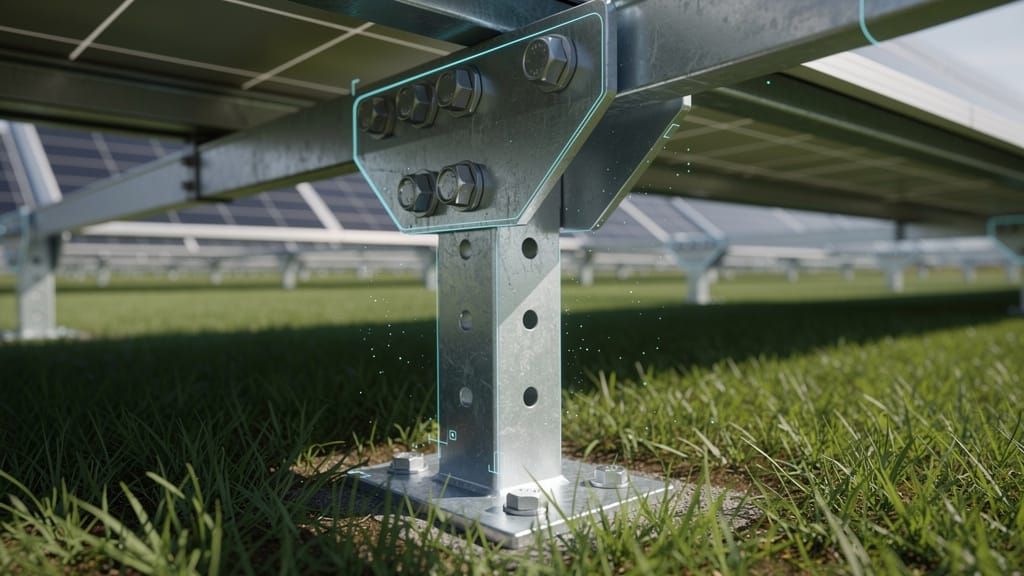
A ground mount costs more to build. Industry figures put the premium somewhere around thirty to fifty cents per watt, which on a ten kilowatt system is roughly three to five thousand dollars. Two things drive that: a foundation, usually driven steel piles or ground screws running a few hundred dollars each, and a trench carrying conductors back to the house, commonly four hundred to twelve hundred dollars for a hundred foot run and considerably more if it has to cross a driveway.
What you buy for the premium is orientation. A roof hands you whatever azimuth and pitch the builder chose. A ground mount lets you face true south at the optimal tilt, and estimates of the resulting gain run from ten to twenty five percent more production from the same modules. Over a system's life that difference compounds against the higher install cost.
There are two secondary advantages that rarely appear in a quote. The first is maintenance: modules at chest height can be cleaned with a hose, snow can be cleared from the ground, and an inverter swap in year twelve does not involve a roof. The second is the roof itself, which stays unpenetrated and can be replaced on its own schedule without anyone removing and resetting an array.
The obstacles are regulatory rather than technical. Ground mounts are structures, so they fall under setback rules, and those vary enormously: some states waive them for solar, while others require anywhere from five to fifteen feet off side and rear property lines, with a handful demanding considerably more. Homeowners' associations have opinions. And in snow country the tilt that maximizes production also determines how the array sheds, which is the one design choice that cannot be revisited later.
One more piece of context belongs in any 2026 payback calculation. The 30 percent federal residential credit expired at the end of 2025, so the arithmetic now rests on state incentives, utility programs, and the local value of the electricity rather than on a federal subsidy.
The Hardware Stack:
IronRidge Ground Mount System: A foundation and racking platform where the tilt angle is an explicit design input rather than whatever the roof offers.
Unirac Ground Fixed Tilt: Another ground racking line, relevant because pile spacing is engineered to the site's wind and snow loads.
Enphase IQ8 Microinverters: Per-module electronics, which make a long conductor run back to the house simpler to design than high-voltage DC would be.
Vulnerability Score
Setback surprise: Local property line setbacks for accessory structures can rule out the obvious location, and they are usually discovered at permit stage rather than at design stage.
Trenching cost: The run from array to house is a civil expense that scales with distance and with whatever it has to cross, and it is easy to underestimate from a map.
Ground exposure: An array at ground level is reachable by mowers, livestock, drifting snow, and vegetation in a way a roof array is not, so fencing and clearance become ongoing items.
Working Out Whether It Fits
Start with the site rather than the system. Find the open area that gets unshaded sun through the middle of the day, measure the distance from there back to the panel, and look up your municipality's setback rule for accessory structures. Those three facts determine most of the answer.
Then ask for both quotes. An installer who can price a roof array and a ground array on the same property will usually show a higher cost and a higher production number for the ground option, and the comparison that matters is cost per kilowatt hour over the system's life rather than the number at the bottom of the first page.
Written by Mason Vance