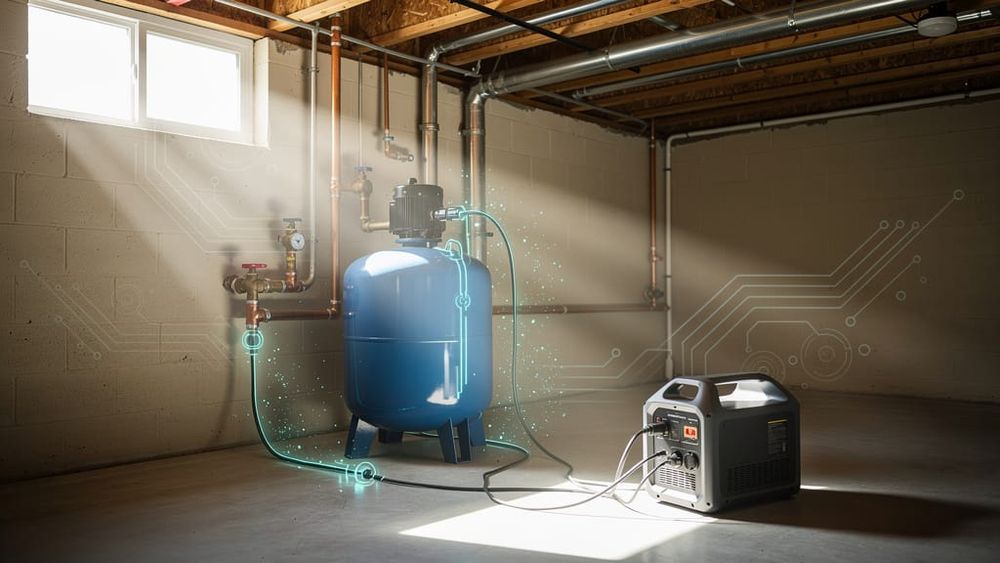
For the roughly 43 million Americans who get their water from a private well, a power outage means something a grid-connected neighbor doesn't have to think about: no electricity, no water pressure, full stop.
Why a Well Pump Is a Different Kind of Load
Most backup power planning focuses on lights, refrigerators, and maybe an internet router. A well pump is a different problem entirely. It doesn't just draw steady power while running, it needs a large momentary surge, often two to three times its normal running wattage, just to get the motor started. A backup system that can comfortably run a refrigerator all day can still fail to start a well pump if it isn't sized for that initial surge.
That's why sizing a backup system for a well starts with the pump's starting wattage, not just its running wattage, and works up from there. For a typical residential pump, that usually means needing a system that can deliver a strong momentary surge alongside enough total stored energy, generally in the range of 8 to 10 kilowatt-hours, to run the pump through a full day of normal household water use.
The equipment for this has become more capable and more flexible than the standard generator setup. Whole-home batteries handle it automatically as part of the house's existing backup power, while portable power stations offer a version of the same capability that doesn't require a permanent installation, useful for a vacation property or as a second layer of backup.
The Hardware Stack:
Tesla Powerwall 3: A whole-home battery with enough continuous output and stored capacity to start and run a typical well pump alongside other household circuits.
EcoFlow Delta Pro 3: A portable power station that can be paired with a smart home panel to deliver the surge a well pump needs without a permanent battery installation.
Anker SOLIX F3800: A portable power station with native 240-volt output, relevant because many well pumps run on 240-volt power rather than standard household 120-volt circuits.
Presented by Porter & Co.
Something strange is happening to your money.
It wasn't voted on. It wasn't debated in the Senate. And most Americans have no idea it's even taking place but…
President Trump is replacing the U.S. dollar.
Not with crypto. Not with a digital currency. Something far bigger than that – and it's already been signed and sealed in the back rooms of D.C., ready to be issued by the U.S. Treasury.
Bypassing every legal and political channel under the guise of "national security," Trump has enacted this total money reset using a landmark executive order (1421).
Whether you’re a Democrat or Republican, whether you support this new money or not, it doesn't matter.
Soon, every U.S. citizen will be forced to use Trump's New Dollar to fill their gas tank, buy groceries, and pay medical bills.
Which is why I've produced a critical new documentary laying out exactly what Trump's New Dollar means for your savings, your investments, and your family's financial future.
Detailing three important steps you can take today to prepare – including the name of a core band of assets connected to Trump’s initiative that could surge as a result.
As you’ll see in my briefing, the last time America reset its money like this – under Richard Nixon’s presidency in the 1970s – it created one of the greatest wealth divides in the history of our nation.
On one side, it minted an average of 1,300 new millionaires a day for over half a century. And on the other… the folks left behind, drowning in debt, with no idea how to use America’s new money to create wealth.
As Trump rolls out his new dollar, the question is:

Good investing,
Porter Stansberry
PS. If you’re wondering what Trump’s new money will look like, when it will be issued, what it means for your investments – all of those questions are answered in my briefing.
Vulnerability Score
No surge capacity: A backup power source sized only for steady household loads may not be able to start a well pump's motor at all, even if it could run it once started.
No 240-volt output: Many well pumps require 240-volt power, which not every portable backup system provides without additional equipment.
No planned runtime: Without calculating how many hours of pump use a backup system needs to cover, a homeowner can end up with a battery that starts the pump but runs out well before water needs for the day are met.
Planning Around the Pump, Not Just the House
None of this requires an unusually large or expensive system for most homes. It requires knowing the well pump's actual starting and running wattage before choosing backup equipment, rather than assuming that whatever handles the refrigerator and the Wi-Fi will handle the pump too.
For anyone on a well already thinking about a battery or a portable power station for outages, the pump is worth sizing for specifically, since it's often the single largest and most demanding load in the house, and the one most likely to get overlooked until the water actually stops running.
The U.S. Just Bought $15 Billion of Its Own Debt (Sponsored by Golden Portfolio)
BlackRock's buying this... are you? (Sponsored by Awesomely)
The biggest capital flow in American history (Sponsored by Porter & Co.)