
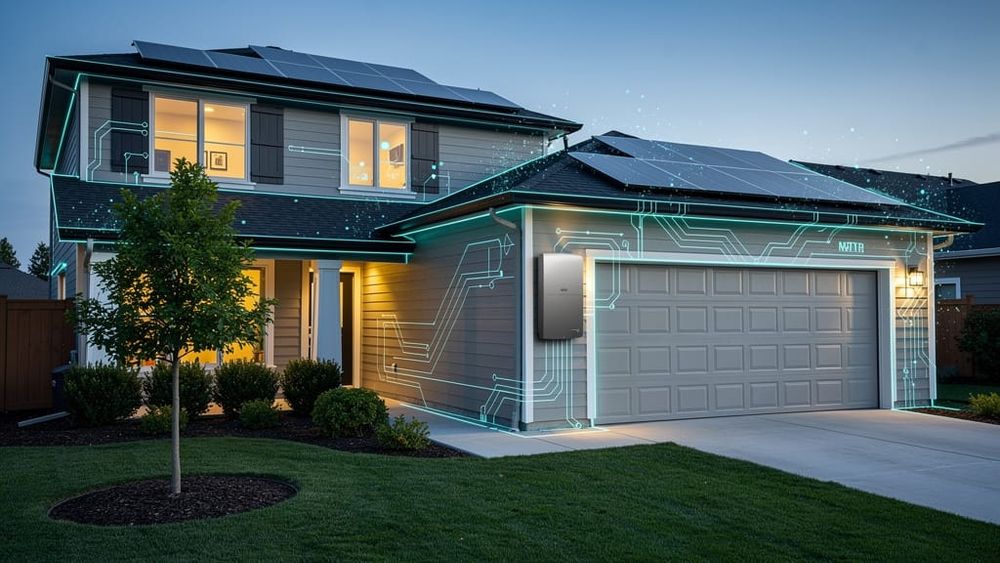
When the power goes out at a home with a smart electrical panel, nothing about the outage itself changes. What changes is what happens in the seconds after, as the panel quietly decides which circuits get to keep running.
The Panel That Makes the Call
A standard electrical panel is a passive piece of equipment. It routes power to circuits and that's the extent of its job. A smart panel adds a layer of circuit-level monitoring and control on top of that same wiring, so it can see how much power each circuit is drawing and switch individual circuits on or off automatically, not just as a group.
That distinction matters most during an outage backed by a battery. A home battery has a fixed amount of stored energy, and running everything in the house at once, air conditioning, the dryer, an EV charger, would drain it in a few hours. A smart panel avoids that by ranking circuits into tiers: refrigeration, essential lighting, and internet or home office equipment typically stay on no matter what, while things like a pool pump, a dryer, or an EV charger get shed automatically when demand rises or the battery gets low. The homeowner sets the priorities once, and the panel enforces them without anyone touching a breaker.
This kind of load management isn't only useful during outages. The same circuit-level visibility lets a panel shift flexible loads, like EV charging or water heating, to whenever solar production or off-peak rates make it cheapest, all without the homeowner having to think about it day to day.
Most of these systems are set up once through a mobile app, where the homeowner sorts circuits into tiers and sets basic rules, then the panel handles the rest in the background. It's a shift from an electrical panel being something a homeowner interacts with only when something trips, to something that's actively managing the home's power use all the time, outage or not.
The Hardware Stack:
SPAN Panel: A full panel replacement with built-in circuit-level monitoring and automatic load prioritization during outages.
Lumin Smart Panel: A control module that installs alongside an existing panel, adding circuit-level switching without a full panel swap.
Schneider Electric Square D Energy Center: An all-in-one smart panel built to integrate solar, battery, and EV charging with digital load control.
Presented by Energy Exploration Technologies
The U.S. Army’s First-of-its-Kind Lithium Deal

For the first time in history, the U.S. Army is placing a commercial lithium processing facility on military land. They just picked their company to build and operate it.
EnergyX won a conditional lease at Texas’ Red River Army Depot to process lithium. Crucial to next-gen military power systems, the defense sector joins AI, EVs, robotics, and more as drivers of demand for this critical mineral.
The project connects directly to Project Lonestar, EnergyX's flagship Texas operation and the largest lithium demo plant of its kind in the United States.
In total, EnergyX’s project portfolio spans nearly 150,000 acres with up to 15M+ tons of untapped lithium.
General Motors, POSCO, Eni, and 50,000+ everyday people have already invested. Join them as an EnergyX shareholder before the July 16 investment deadline.
Vulnerability Score
No circuit-level visibility: A standard panel can't tell which circuit is drawing power at any given moment, so a homeowner has no way to see or manage demand without walking to the breaker box.
No automatic prioritization: Without a smart panel, protecting a refrigerator or a home office during an outage means manually flipping breakers, if the homeowner is even home to do it.
No coordination with a battery: A standard panel treats every circuit the same, so a battery drains at the same rate whether it's powering a refrigerator or a hot tub..
What This Means for Homeowners Weighing the Decision
A smart panel isn't a requirement for solar or battery storage to work, and plenty of systems run fine without one. But for a home that already has a battery, or is considering one, a smart panel is often what determines how long that battery actually lasts during an outage, and how much day-to-day flexibility it adds the rest of the time.
For homeowners comparing systems, it's worth asking not just how big the battery is, but what's actually deciding where that stored power goes once the grid drops out.
I missed Bitcoin at $800. This is my redemption trade (Sponsored by Awesomely)
This is a national security imperative (Sponsored by Porter & Co.)
Trump’s dollar reset exposed (Sponsored by Porter & Co.)
Disclaimer
Energy Exploration Technologies, Inc. (“EnergyX”) has engaged Genius Marketing to publish this communication in connection with EnergyX’s ongoing Regulation A offering. Genius Marketing has been paid in cash and may receive additional compensation. Genius Marketing and/or its affiliates do not currently hold securities of EnergyX. This compensation and any current or future ownership interest could create a conflict of interest. Please consider this disclosure alongside EnergyX’s offering materials. EnergyX’s Regulation A offering has been qualified by the SEC. Offers and sales may be made only by means of the qualified offering circular. Before investing, carefully review the offering circular, including the risk factors. The offering circular is available at invest.energyx.com. Comparisons to other companies are for informational purposes only and should not imply similar results.