Backup power lists usually cover the refrigerator, the furnace blower, the well pump, and the router. In a cold climate there is one more, and it is the only load on the list whose entire purpose is to run during exactly the conditions that cause the outage.
What Freeze Protection Actually Draws
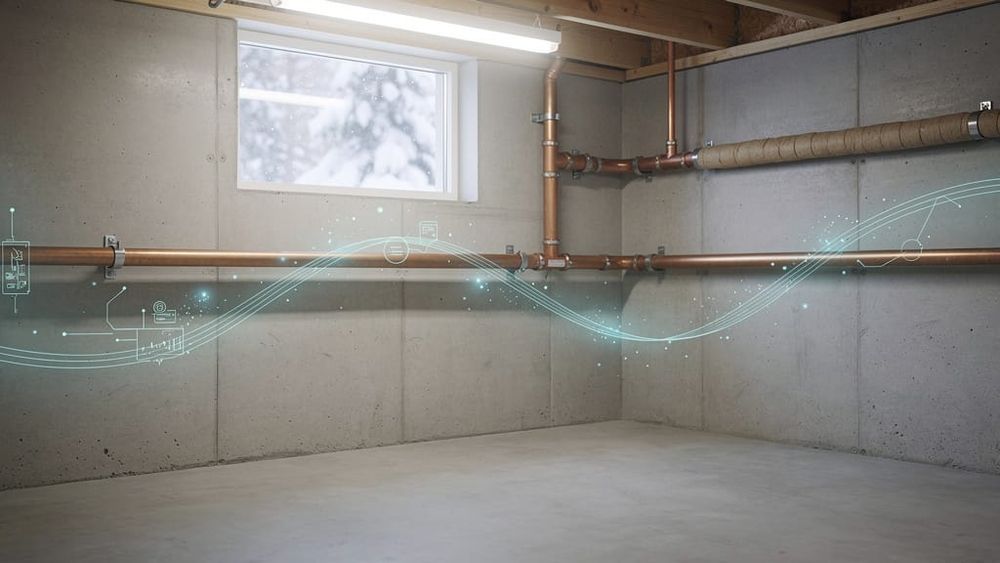
Electric heating cable, commonly called heat tape, is what keeps exposed pipes, well heads, and roof edges from freezing. Residential cable is usually rated somewhere in the range of three to twelve watts per foot, with most household products falling around six to nine.
The arithmetic gets interesting quickly. A fifty-foot run at eight watts per foot draws 400 watts when energized. At roughly thirty percent duty cycle over a cold day, that is close to three kilowatt hours in twenty four hours from one cable. A house with several protected runs can be carrying a load comparable to the refrigerator, continuously, in the weather where every other load is also at its worst.
There are two types and the difference matters for a backup calculation. Constant wattage cable draws its full rating whenever it is energized, so it depends entirely on a thermostat to avoid running all winter. Self-regulating cable has a polymer core that increases output as it gets colder and reduces it as it warms, and it can use meaningfully less energy than a fixed-output cable over a season. For a battery or generator, self-regulating cable is the better behaved load because it throttles itself instead of cycling hard.
The cheapest improvement is not electrical at all. Insulating the pipe reduces how much heat the cable has to supply in the first place, which cuts both the duty cycle and the peak. A thermostat that only energizes the circuit below about 40 degrees Fahrenheit does the rest.
The reason this belongs in a resilience conversation rather than an efficiency one is the timing. A multi-day winter outage is precisely when the pipes are most at risk and when stored energy is scarcest. A household that has not accounted for freeze protection can find itself choosing between heat and plumbing on the second night.
The Hardware Stack
- Easy Heat Freeze Free: A self-regulating pipe heating cable, which adjusts output with temperature instead of drawing a fixed wattage.
- Frost King Automatic Heat Cable Kit: A thermostatically controlled cable kit, which is the common retail approach to a single exposed run.
- SPAN Smart Panel: Circuit-level control, which is what allows freeze protection to be shed or prioritized deliberately during a long outage.
Vulnerability Score
Unbudgeted draw: Heat cable runs continuously in the cold and is rarely included in backup load calculations, so the real winter demand exceeds the planned one.
Concurrent risk: Freeze protection is needed during the same storms that cause outages, which means it competes for stored energy at the worst possible moment.
Untested circuit: A cable installed years ago and never tested may have failed without any symptom until the pipe it protects freezes.
Putting It in the Plan
Walk the house before the cold and write down every heating cable, its length, and its rating, which is printed on the cable or the packaging. Multiply length by watts per foot and you have the number that belongs in the backup calculation.
Then decide in advance where it sits in the priority order. For most households the honest answer is that freeze protection outranks nearly everything except the furnace, because a frozen pipe is a repair bill rather than an inconvenience. Knowing that now, while the cable can still be insulated, thermostatted, or moved to a controlled circuit, is worth far more than discovering the load on the second night of a February outage.
Written by Mason Vance