Before spending money on a bigger heat pump, more insulation, or a battery sized to carry a house through a winter night, it is worth knowing how much air that house is leaking. There is a standard test for exactly this, it takes a couple of hours, and in many territories the utility pays for it.
Sponsored by Brownstone Research
Distracted Americans set to miss out on quadrillions
Editor’s Note: What if you could claim a stake in a technology set to become 100X bigger than Bitcoin… starting with just $2? Click here to see the details from investing legend and Washington D.C. insider Jeff Brown — the man who picked Bitcoin, Tesla, and Nvidia before they exploded higher. Or read more below.
Dear Reader,
Nothing is ‘normal’ anymore.
Amid war, soaring gas prices, all-time-high stocks, it’s all but impossible to figure out what’s coming next.
Higher stocks?
An AI crash?
Shortages?
Today, technology expert Jeff Brown is keeping an eye on all the issues facing Americans.
But he says there’s a revolution coming to our financial system that few understand.
In short, he says:
“We’re about to witness a complete overhaul to our financial system. It has nothing to do with AI or a new kind of dollar… but it will mean the end of the stock market as we know it, and the beginning of a new way of investing.”
According to Brown’s research, hundreds of trillions of dollars could soon move.
Goldman Sachs is racing to prepare, along with Citi, Chase, and more than 50 other major institutions.
And, between now and July, a key piece of legislation could fast-track adoption worldwide.
To see all of Jeff’s research free of charge, click here.
When you do, you’ll see all the details of this new technology, and Jeff will explain how you can prepare before it’s too late.
Best,
Lindsey Hough
Managing Director, Brownstone Research
P.S. Today, Americans are distracted by war, shortages, data centers, and summer vacations. Right now, you have the opportunity to see the shape of what’s coming before it hits the mainstream media.
Go here to see all the details.
What a Blower Door Actually Measures
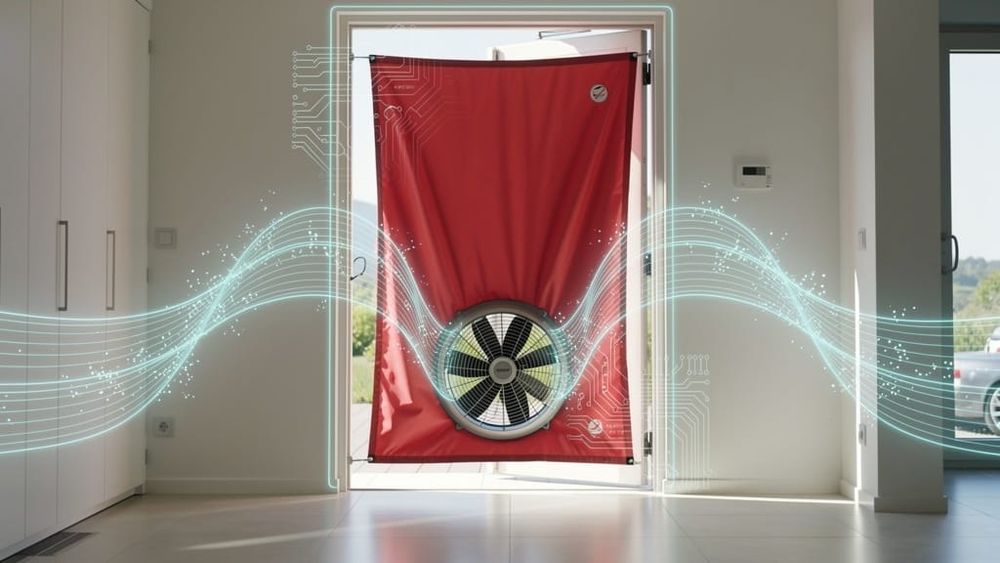
A blower door is a calibrated fan mounted in an exterior doorway. It depressurizes the house to 50 pascals, roughly the pressure of a steady 20 mile per hour wind pushing on every surface at once, and measures how much air the fan has to move to hold it there. Whatever the fan moves is what the house is leaking.
Two numbers come out. CFM50 is the raw airflow in cubic feet per minute at that pressure. ACH50 divides that by the volume of the house, giving air changes per hour, which is the figure that lets you compare a bungalow to a colonial fairly. Lower is tighter. A typical existing home lands around 7 to 10 ACH50. Code-compliant new construction targets 3 to 5.
Pricing is modest. A standalone blower door test runs $150 to $400, with most homeowners paying $250 to $350. Bundled into a full energy audit with an infrared scan and a written report, it runs $300 to $700. Many utility efficiency programs cover the whole thing at no cost or a small copay, which is worth checking before paying retail.
The number itself is the least useful part of the result. What matters is the leak map: the prioritized list of where the air is actually moving. In most houses the answer is unglamorous and consistent. Attic hatches. Top plates where interior walls meet the attic. Rim joists in the basement. Duct chases and plumbing penetrations. Not, generally, the windows everyone blames.
There is an energy-independence angle here that gets missed. Every kilowatt-hour a leaky house needs to stay warm is a kilowatt-hour a battery has to store or a generator has to make. Air sealing is the cheapest capacity you will ever buy, because it reduces the size of the problem rather than the cost of the solution.
The Hardware Stack:
Minneapolis Blower Door: The calibrated fan and manometer system most auditors use, which is why results from different auditors are comparable.
FLIR E8 Pro: A thermal camera used during depressurization to make leaks visible, since air moving through a gap changes the surface temperature around it.
Sense Home Energy Monitor: Useful after the work, because it shows whether heating runtime actually dropped once the sealing was done.
Vulnerability Score
Oversized equipment: HVAC and backup systems sized for a leaky house cost more up front and cycle inefficiently once the house is sealed, so the order of operations matters.
Misplaced spending: Replacing windows before air sealing is the most common expensive mistake, since windows are rarely the largest leak in an older house.
Unmeasured baseline: Without a before number there is no way to know whether weatherization work achieved anything, which makes the contractor's claim the only evidence.
Doing This in the Right Order
Call your utility first and ask whether they offer a subsidized energy assessment. Many do, and a free test with a written report is the best value in this entire subject area.
Then use the order the physics implies: seal, then insulate, then size the equipment. A house tested at 9 ACH50 and brought down to 5 needs meaningfully less heating and cooling, which changes what size heat pump to buy and how many kilowatt-hours of storage it takes to ride out a winter night. Doing it the other way around means paying for capacity that better sealing would have made unnecessary.

Written by Mason Vance
The Next Starbucks Is Brewing in Colombia (Sponsored by Green Coffee Company)