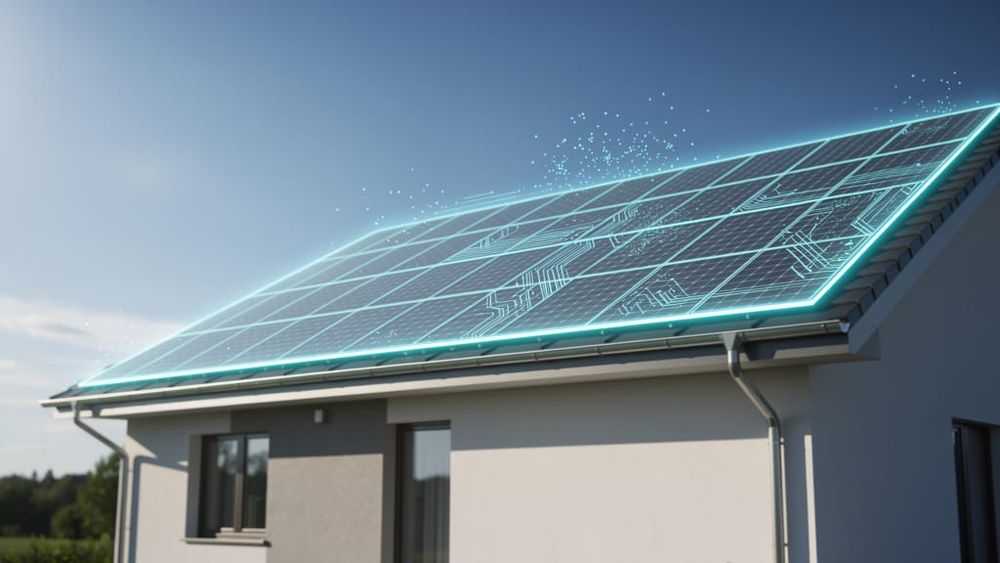
Solar panels do not have an off switch. As long as light is falling on them, the wiring between the modules and the inverter is live, whether or not the inverter is running. That is the problem a code rule called rapid shutdown exists to solve, and it is the reason your array almost certainly has electronics on the roof that you have never thought about.
What Rapid Shutdown Actually Does
Section 690.12 of the National Electrical Code requires that a rooftop array can be brought down to a safe voltage within 30 seconds of someone pressing a button. The point is firefighters. A crew cutting a ventilation hole in a roof needs to know the conductors under their saw are not carrying several hundred volts of direct current.
The rule draws an imaginary line one foot out from the edge of the array in every direction, called the array boundary. Outside that boundary, conductors have to drop to 30 volts or less. Inside it, the common approach limits conductors to 80 volts or less, though a system listed as a PV Hazard Control System under UL 3741 can meet the requirement a different way.
Two kinds of hardware satisfy this in practice. Microinverters convert direct current to alternating current at each individual panel, so there is no high-voltage DC on the roof to begin with. Power optimizers sit behind each module and throttle its output down when the shutdown signal arrives. Either way the electronics are up on the roof with the panels, which is worth knowing because roof-mounted electronics are also the parts most exposed to heat cycling and weather.
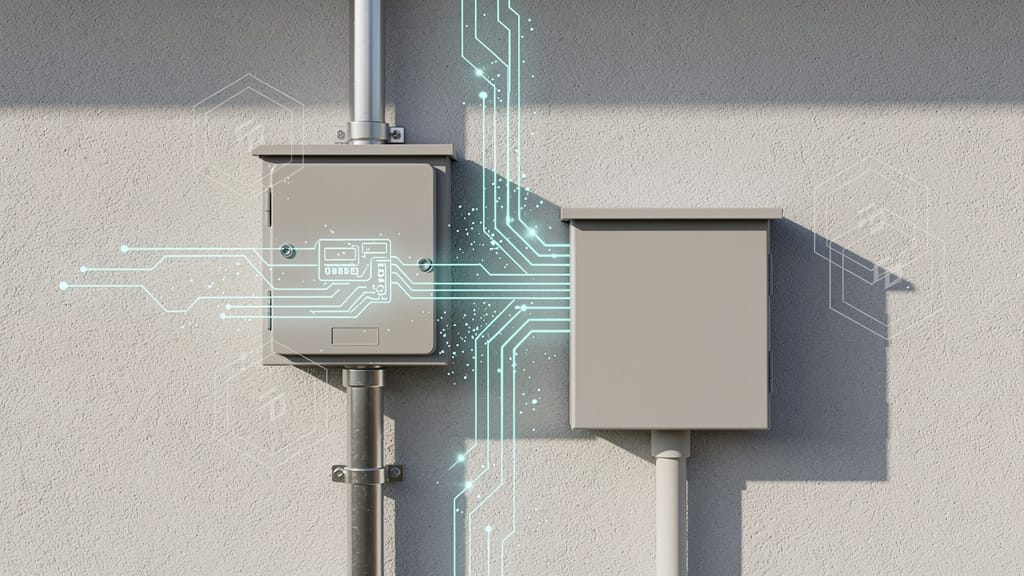
The switch itself is usually a labeled red button near the main service disconnect or the inverter. If you have solar and cannot say where yours is, that is a five-minute thing to resolve. Firefighters look for it, and a labeled, reachable disconnect is part of what makes an array safe to work around.
The Hardware Stack:
Enphase IQ8 Microinverters: Convert DC to AC at each module, so the roof carries no high-voltage DC and rapid shutdown is inherent to the design.
SolarEdge Power Optimizers: Module-level electronics paired with a matched SolarEdge inverter, dropping module output to a safe level when the initiator opens.
Tigo TS4-A-2F: A retrofit rapid shutdown device that adds compliance to an existing string array without replacing the inverter.
Vulnerability Score
Live conductors: A pre-code array without rapid shutdown keeps its DC wiring energized in daylight regardless of whether the system is switched off at the panel.
Unlabeled disconnect: An initiator no one can find is functionally the same as not having one, since responders will not search a burning house for an unmarked button.
Mismatched equipment: Optimizers and inverters are certified as a pair. Swapping an inverter for a different brand can quietly break compliance even though the system still produces power.
The Two Things Worth Checking
If your system was installed in the last several years, it almost certainly complies, because inspectors have been enforcing this for a while now. The useful checks are simpler than the code language suggests.
First, find the rapid shutdown initiator and make sure the label is still legible. Sun and weather fade adhesive labels within a few years, and a faded label is a cheap thing to replace.
Second, if you are planning an inverter replacement, ask the installer to confirm the new inverter is certified with your existing module-level electronics. That pairing is the part most likely to be overlooked in a swap, and it is much easier to sort out before the equipment is on order than after.
Written by Mason Vance