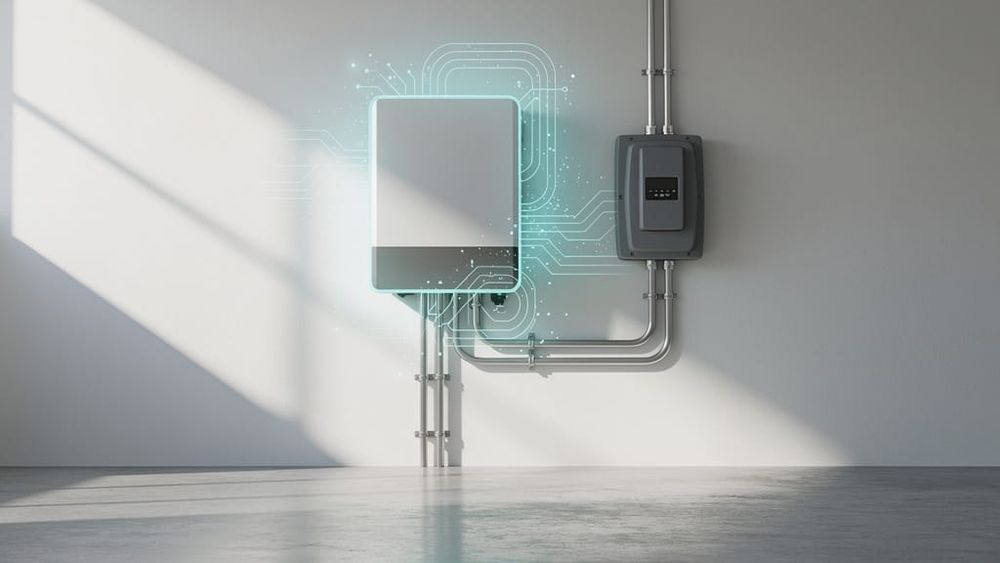
The panels on a residential array are warranted for 25 years. The box that converts their output into usable power usually is not. A string inverter runs about 10 to 15 years and carries a 10 to 12 year warranty, which means most homeowners who keep a system to the end of the panel warranty will buy an inverter twice.
Sponsored by Brownstone Research
Forget Mag7 – this is where smart money is flowing
Dear Reader,
This is urgent.
A new type of AI called “Accelerated AI” is about to take the world by storm…
And stocks connected to it are already breaking out.
Check this out…
One “Accelerated AI” stock just moved 133%...
A second ripped 320% in less than three months…
And a third company jumped over 210% in under four months…
All the while Tesla, Microsoft, Meta… even the king of AI — Nvidia… kept going sideways.
And it’s just getting started.
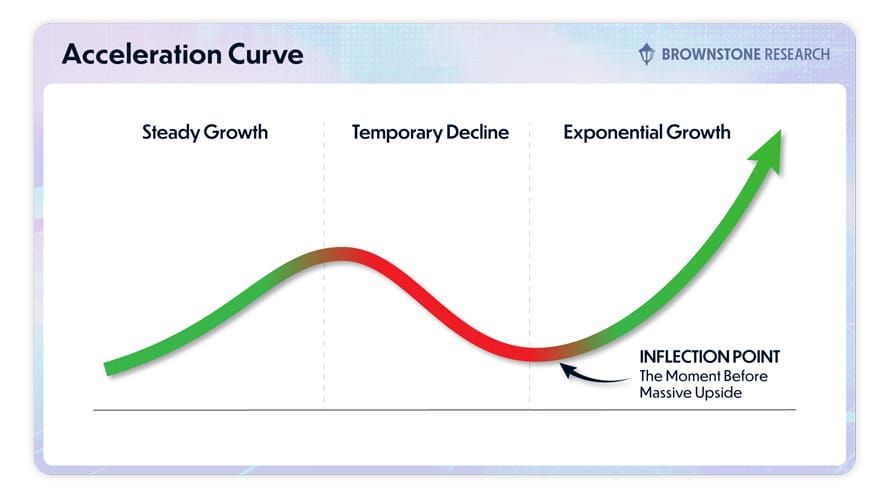
At the inflection point right before “Accelerated AI” explodes into the mainstream…
And unlocks an entire new dimension of exponential growth.
If history is any guide, we could be looking at potential gains of up to 10,000% from here.
If you want to find out more about “Accelerated AI”…
The “light-speed” device powering it…
Why it’s about to crack open the next wave of AI fortunes…
And the #1 “Accelerated AI” play everyone should buy right now — for free…
Let the money flow to you,
Jason Bodner
Founder, Inflection Point
Why the Inverter Ages Faster Than Everything Else
A solar panel is a sealed sheet of silicon and glass with no moving parts and nothing that switches. An inverter is a power electronics device running constantly through daily thermal cycles, with capacitors, cooling fans in some designs, and semiconductors that switch thousands of times a second. It is the part of the system that behaves like an appliance rather than like a roof.
The replacement numbers are worth knowing before they arrive. A string inverter runs $800 to $1,800 for the unit and $1,500 to $3,000 installed. A single failed microinverter is $150 to $250 for the part plus $100 to $200 of labor, but it is up on the roof, so getting to it costs more than the part. A hybrid inverter paired with battery storage is a different scale entirely, $11,000 to $14,000 installed, because you are replacing the storage system's brain along with it.
That difference is the real argument in the microinverter versus string inverter debate, and it is usually framed as an upfront cost question when it is actually a lifecycle one. Microinverters carry 25-year warranties that match the panels, so in principle the electronics retire with the array. Power optimizers split the difference: the optimizers are rated for 25 years while the central inverter they feed still carries a 12-year warranty.
The failure signs are unglamorous and easy to miss. Error codes on the display. A dark display where there used to be numbers. No AC output on a sunny afternoon. A system that will not restart after cycling both the DC and AC disconnects. A burned-out LCD screen is worth taking seriously on its own, because it usually means the unit has been running hot for a long time.
The Hardware Stack:
SolarEdge Home Hub Inverter: A string-type unit with a 12-year standard warranty, extendable, paired with optimizers rated for the life of the panels.
Enphase IQ8 Microinverters: Per-module electronics with a 25-year warranty, replaced individually rather than as a single point of failure.
Tesla Powerwall 3: An example of the hybrid case, where the inverter and the battery are one product and replacement means replacing both.
Vulnerability Score
Unbudgeted mid-life cost: A system financed over 20 years with a 12-year inverter warranty has a four-figure expense sitting in the middle of the loan that the original quote never mentioned.
Single point of failure: A string inverter failure takes the entire array offline until it is replaced, not one panel.
Discontinued model: After a decade, an exact replacement may no longer exist, and a different inverter can force changes to monitoring, rapid shutdown compliance, or the optimizers it has to talk to.
What to Check on Your Own System
Two pieces of information settle most of this. Find the inverter's install date and its warranty length, both of which are in your original paperwork or on the unit itself. If the warranty expires before your loan does, that gap is a real number you can plan around.
If you are still shopping, ask each quote to state the inverter warranty separately from the panel warranty, and ask what a replacement costs at today's prices. A cheaper system with a 12-year inverter and a more expensive one with 25-year microinverters often converge once that replacement is in the arithmetic, which is exactly the comparison a good installer will walk you through without being asked twice.
Written by Mason Vance
The 40,000% Coffee Precedent (Sponsored by Green Coffee Company)
Your coffee order costs more than this. Yes, really. (Sponsored by Millionaire Media)
Giving “2022 pre-ChatGPT” vibes (but 10x bigger) (Sponsored by StocksToTrade.com)
“Elon’s nightmare” could fund your retirement (Sponsored by Chaikin Analytics)
Buy this stock tomorrow (Sponsored by Chaikin Analytics)
SpaceX: Elon Musk’s ‘Trojan Horse’ (Sponsored by Altimetry)
SpaceX S-1 Filing Reveals Elon's Hidden AI Master Plan (Sponsored by Altimetry)
Our #1 AI Stock of 2026 (not AI) (Sponsored by InvestorPlace Media)
Are you a speculator or an investor? (Sponsored by Freedom Financial Research)
Wall Street quietly buying these stocks before November 3? (Sponsored by Brownstone Research)
Elon Musk's Empire Secretly Runs on This… (Sponsored by Omnia Research)
Elon Musk on His New Invention: “An Infinite Money Glitch.” (Sponsored by Brownstone Research)
Where to Put $100 Before Trump’s New Tech Law Rolls Out (Sponsored by Brownstone Research)
This loan shouldn't be possible (Sponsored by Behind the Markets)
The banks know something you don't (Sponsored by Behind the Markets)
Elon's Next IPO... a Flop? (Sponsored by Awesomely)