A sump pump has one job and one bad habit: the storm that fills the pit is often the same storm that takes down the line feeding the pump. The failure is not the pump. It is the assumption that grid power will be there at the moment the pit needs emptying.
Sponsored by Chaikin Analytics
How to Profit off Anthropic's Project Glasswing

Anthropic's Project Glasswing gives a select group of companies early access to an advanced form of AI that has been deemed "too dangerous" for the public. With this in their arsenal, these companies could become the most powerful businesses in the world this year. To see which stocks could emerge as the biggest winners and losers as this technology cleaves the market in half, click here for FREE names, tickers, and buy/sell recommendations.
This ad is sent on behalf of Chaikin Analytics, 201 King Of Prussia Rd., Suite 650, Radnor, PA 19087. If you would like to optout from receiving offers from Chaikin Analytics please click here.
Three Ways to Keep the Pit Empty
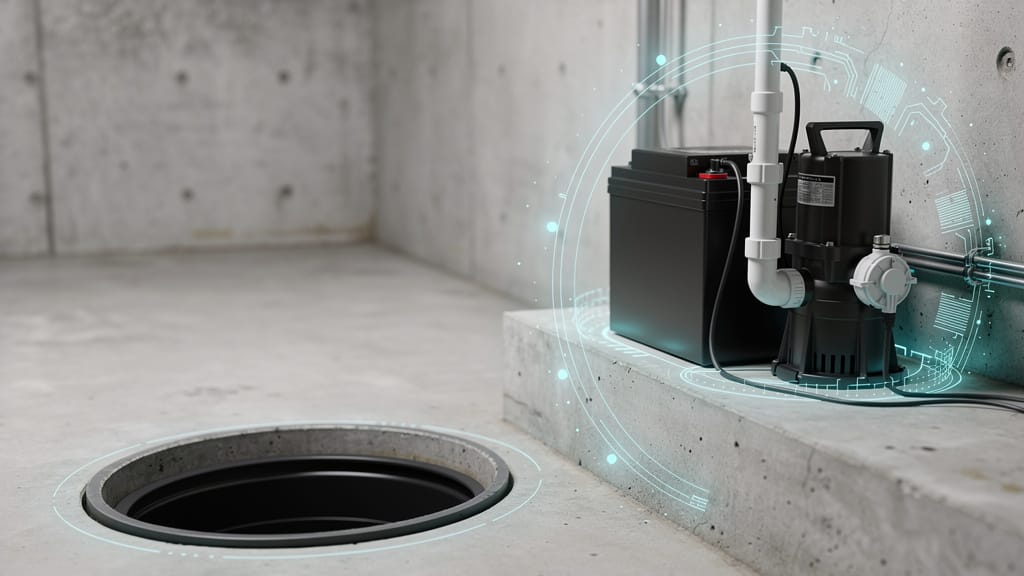
The standard answer is a dedicated battery backup pump. It sits beside the primary pump with its own float switch and its own 12-volt battery on a trickle charger. When the primary stops, whether from a power cut or a failed motor, the backup takes over. A Wayne ESP25 moves up to about 2,700 gallons per hour at low head, which is enough for most residential pits, and units in this class typically hold up for several hours of intermittent cycling on a single deep-cycle battery.
The second answer is a water-powered backup, which uses municipal water pressure to drive an ejector that pulls water out of the pit. It needs no electricity at all, which is its whole appeal, and it needs city water pressure, which rules it out for anyone on a well. It also uses a meaningful volume of city water to move a given volume of pit water, so it is a last-resort device rather than a routine one.
The third answer is to put the existing pump on whole-home backup. This works, but sizing matters more than people expect. A sump pump motor draws a brief surge when it starts, several times its running current, and a battery system has to be able to supply that spike as well as the steady draw. Running the pump on a generator or a home battery means confirming the circuit is actually included in the backup loads, which is a decision made when the transfer switch or smart panel is configured, not afterward.
Whichever route you take, the maintenance is the part that gets skipped. A backup battery has a service life of a few years and gives no warning when it reaches the end. A float switch can hang up on debris or a wall. The check that catches both is pouring a bucket of water into the pit and watching what happens, twice a year, which takes about five minutes.
The Hardware Stack:
Wayne ESP25: A 12-volt battery backup pump rated up to about 2,700 gallons per hour, installed alongside the primary pump with its own float.
Zoeller Aquanot 508: A backup system with a controller that monitors battery condition and alarms on a failed charge, addressing the silent-battery-death problem.
Basepump RB750: A water-powered backup that runs on municipal water pressure and needs no electricity, for homes on city water.
Vulnerability Score
Single point of failure: A basement with one pump and no backup depends entirely on the grid staying up during the exact weather that most often takes it down.
Silent battery death: A backup battery that failed two years ago looks identical to a working one until the night it is needed, unless the controller monitors and alarms.
Unbacked circuit: A house with whole-home backup can still flood if the sump circuit was never included in the backed-up loads when the panel was configured.
The Cheapest Version of This
If your basement holds anything you would mind losing, a backup pump is one of the better returns in home resilience. The hardware is a few hundred dollars, the install is within reach of a competent DIYer, and the failure it prevents is expensive and slow to clean up.
The step before buying anything is worth more: find out whether your sump circuit is on your backup system today. If you have a generator or a battery, that answer is in the transfer switch or the panel app, and it takes a minute to look up. Plenty of homes discover during the outage that the pump was never on the list.
Written by Mason Vance
The exclusive U.S. distributor of Juan Valdez is $1.10/share (Sponsored by Green Coffee Company)
Get ready for August 15 market shock (Sponsored by Omnia Research)
Millionaire warns: Move your money now (Sponsored by Omnia Research)
Why one Friday trade could change your Mondays (Sponsored by Millionaire Publishing)
Forget SpaceX, this is Elon’s Next Breakthrough (Sponsored by Brownstone Research)
Where to Put $100 Before Trump’s New Tech Law Rolls Out (Sponsored by Brownstone Research)