A tree comes down, the wire to the house comes with it, and the crew arrives, looks at the damage, and says they cannot restore power until an electrician has been out. That sentence surprises most homeowners, and it comes down to an ownership line that runs straight through the middle of the equipment on the side of the house.
Sponsored by Green Coffee Company
Get a Stake in Green Coffee Company Before a Potential Exit
For $1,001, you can purchase approximately 910 shares of Green Coffee Company at the current offering price of $1.10 per share.
What does that give you exposure to?
45 Colombian coffee farms, consolidated together into the #1 largest producer in the country.
Around 10 million coffee trees.
Proprietary processing facilities capable of handling more than one million pounds per week.
A business that grew revenue from $1 million in 2021 to $26 million in 2025.
Products that have already reached more than 3,000 retail locations.
And exclusive third-party rights involving Juan Valdez roasted-coffee products across U.S. and Canadian retail and institutional channels.
This is not an investment in a café concept hoping to open its first location.
It is an opportunity to own shares in a vertically integrated coffee company already growing, processing, roasting and distributing Colombian coffee at scale.
Green Coffee Company is working to capture value across the supply chain—from the farm where the coffee is grown to the shelf where the finished product is sold.
Until recently, investments like this were often reserved for venture funds and wealthy accredited investors.
Today, individual investors can participate.
No accreditation is required, and the minimum investment is $1,001.
The company is still private, so liquidity is limited and returns are never guaranteed. But for investors who understand the risks, this is a chance to gain early exposure to an established coffee operation before a potential future liquidity event.
Click here to review the offering and see exactly what your investment buys.
Where the Boundary Sits
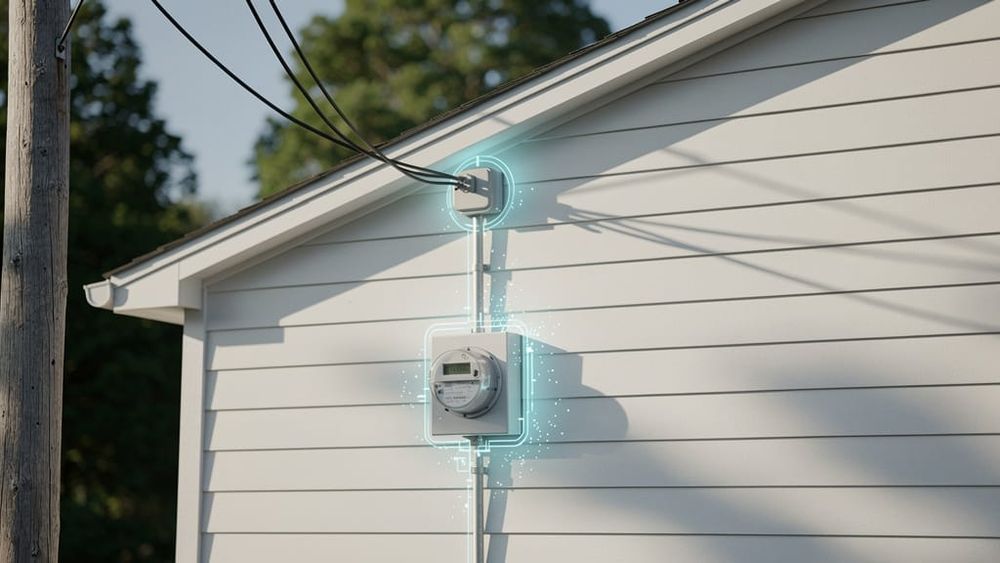
Walk out and look at the connection. On an overhead service there is a pole, a span of wire to the house, a point where it attaches, a curved fitting where the conductors enter a vertical pipe, a meter, and then the panel inside.
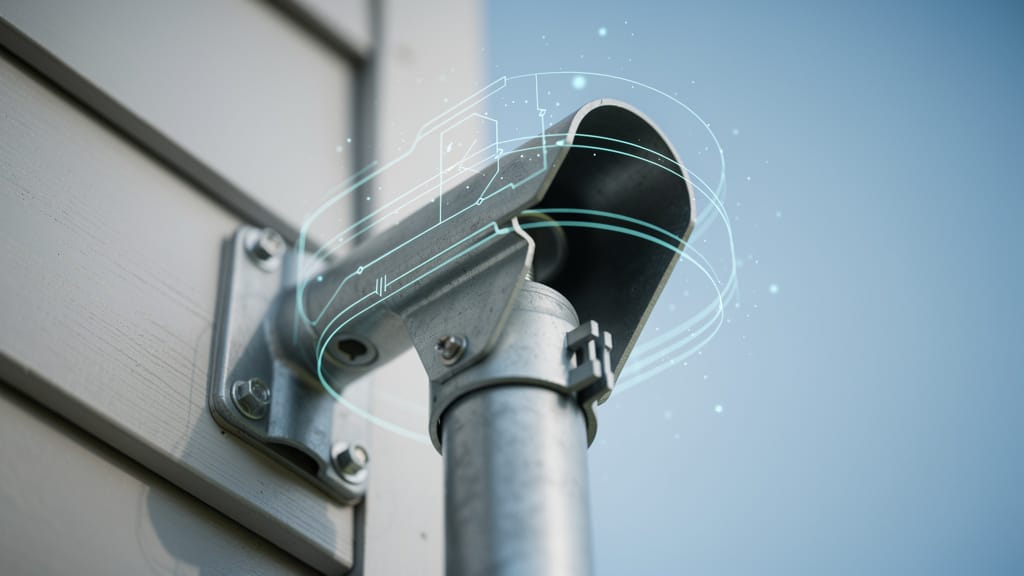
In most territories the utility owns the span of wire and the connection at the end of it. Almost everything bolted to the house is the customer's: the attachment point, the mast or conduit the conductors run down, the weatherhead at the top, and usually the meter socket itself, even though the meter inside it belongs to the utility. The exact line varies by utility and by state, which is why this is worth confirming locally rather than assuming.
That split is what produces the delay. If the span of wire failed, the crew replaces it and leaves. If the mast was pulled away from the wall or the weatherhead was torn off, that is the homeowner's equipment, and the utility will not reconnect to broken equipment. The sequence becomes electrician, then inspector in many jurisdictions, then utility, and each step is a separate appointment in a week when everyone is busy.
Underground services follow the same logic with different hardware. The buried cable from the transformer, often called the service lateral, is sometimes utility-owned and sometimes not, and in territories where it belongs to the customer a failed lateral is an expensive private excavation rather than a utility repair.
There is a maintenance angle worth more than the outage one. The mast and weatherhead sit outdoors for decades. Rust at the base, a mast that has started to lean, a cracked weatherhead boot, or conductor insulation gone brittle where it leaves the fitting are all things you can see from the ground, and all things that are far cheaper to fix on a clear Tuesday than during a storm restoration queue.
The Hardware Stack
Siemens Meter Main Combination: The meter socket and main breaker in one enclosure, which is the customer-side equipment a service upgrade usually replaces.
Ting by Whisker Labs: A plug-in monitor that watches the electrical waveform for the arcing signature a failing service connection produces.
Sense Home Energy Monitor: Records voltage at the panel, which is where a deteriorating service connection shows up as sag before it shows up as an outage.
Vulnerability Score
Split responsibility: Damage on the customer side of the boundary has to be repaired privately before the utility will reconnect, which adds days to an individual restoration.
Invisible decay: Masts, weatherheads, and service conductors age outdoors for decades with no inspection, and the failure is usually discovered during the weather that caused it.
Underground uncertainty: Where the buried service lateral belongs to the homeowner, a failure means excavation at the owner's cost, which is a very different bill from a utility repair.
Ten Minutes and One Phone Call
Go outside and photograph the service entrance from a few angles while the weather is good. Look for rust streaks at the base of the mast, a lean, separation where it meets the wall, and cracking in the insulation at the weatherhead.
Then call your utility, or find the ownership diagram on their website, and learn exactly where their responsibility ends at your address. Many publish a simple drawing showing which parts are theirs. Knowing that before a storm turns a confusing conversation in the driveway into a phone call you can make immediately, to the right trade, while the queue is still short.
Written by Mason Vance
Elon’s 100X AI Stock (Sponsored by Behind the Markets)
Forget SpaceX, this is Elon’s Next Breakthrough (Sponsored by Brownstone Research)
Any discussion of securities, assets, or financial markets in this email is for informational context only and does not represent investment guidance of any kind.