
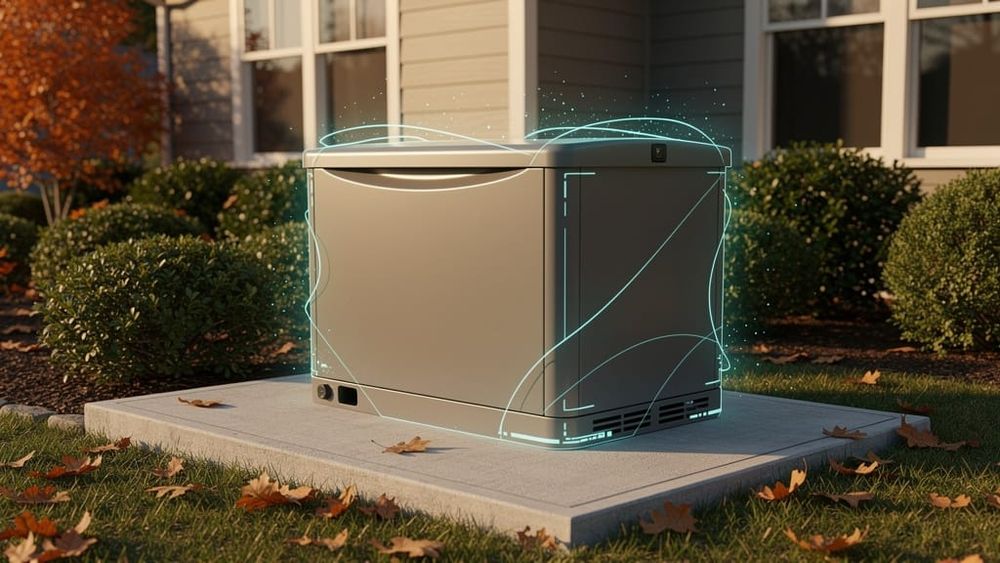
A home standby generator sits outside for years doing almost nothing, and then is asked to start on the worst night of the year. When one does not start, the cause is usually not the engine, the fuel, or the transfer switch. It is a twelve-volt battery about the size of the one in a riding mower.
Why the Smallest Component Decides the Outcome
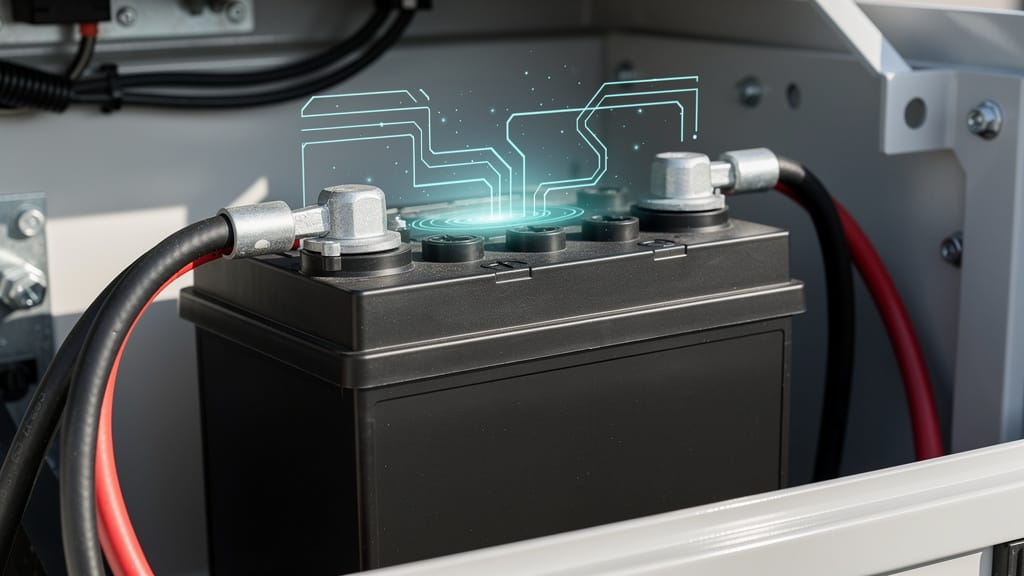
A standby generator is a small engine, and a small engine needs a starter motor, and a starter motor needs a battery. Everything else in the system can be in perfect condition, but if the battery cannot turn the engine over for the few seconds required, nothing happens. Service technicians consistently name a weak or dead starting battery as the most common reason a standby unit fails to run.
Two things work against that battery. The first is that it lives outdoors, cycling through summer heat and winter cold, both of which shorten lead-acid life. The second is that it almost never gets exercised in the way a car battery does. It sits on a trickle charge from the generator's controller, and a battery held at float for years quietly loses capacity without giving any sign until it is asked to deliver current. Many installers recommend replacing it on a schedule of roughly every two years rather than waiting for it to fail.
The other failure modes follow a similar pattern of slow, invisible decline. Low oil triggers a protective shutdown, so an engine that has quietly consumed or leaked oil refuses to start rather than damage itself. Air in the fuel line causes extended cranking. Corroded terminals produce a connection that looks fine and passes almost no current.
This is what the weekly exercise cycle is for. Most standby units start themselves and run briefly on a set schedule, and the point is everything around the engine: the battery gets a real load, the fuel system circulates, and the controller logs a fault while you can still act on it.
The trouble is that the exercise runs while nobody is listening. A unit that has been failing its cycle for three months looks identical to one that has been passing.
The Hardware Stack
- Generac Guardian Series: A common residential standby platform whose controller runs a scheduled self-test and logs faults that a homeowner can read at the unit.
- Battery Tender Battery Charger: A maintenance charger for the starting battery, which matters on units where the factory trickle charge is marginal.
- NOCO GB40 Jump Starter: A portable lithium jump pack, which will start a standby generator with a weak battery long enough to get through the night.
Vulnerability Score
Silent standby: A generator that has failed its self-test gives no outward sign, so the discovery usually happens during the outage it was bought for.
Aging battery: Lead-acid capacity declines with heat, cold, and years on float charge, and a battery that reads a normal voltage can still be unable to deliver starting current.
Missed maintenance: Oil level, fuel line condition, and terminal corrosion all produce a no-start on a unit that appeared perfectly healthy sitting there.
The Twenty Minutes That Settles It
Before the season, do three things. Check that the exercise cycle is actually running by noting the day and time it is set for and being home to hear it once. Look at the battery terminals for the white or green crust that means a bad connection. And check the age of the battery, which is usually stamped on the case, against the two-year guideline.
The stronger version is a load test under real conditions: kill the utility feed at the disconnect, let the generator start and carry the house for fifteen minutes, then restore. That tests the battery, the fuel, the controller, and the transfer switch together, which is the only way to learn that one of them is not ready while there is still a Tuesday afternoon available to fix it.
Written by Mason Vance