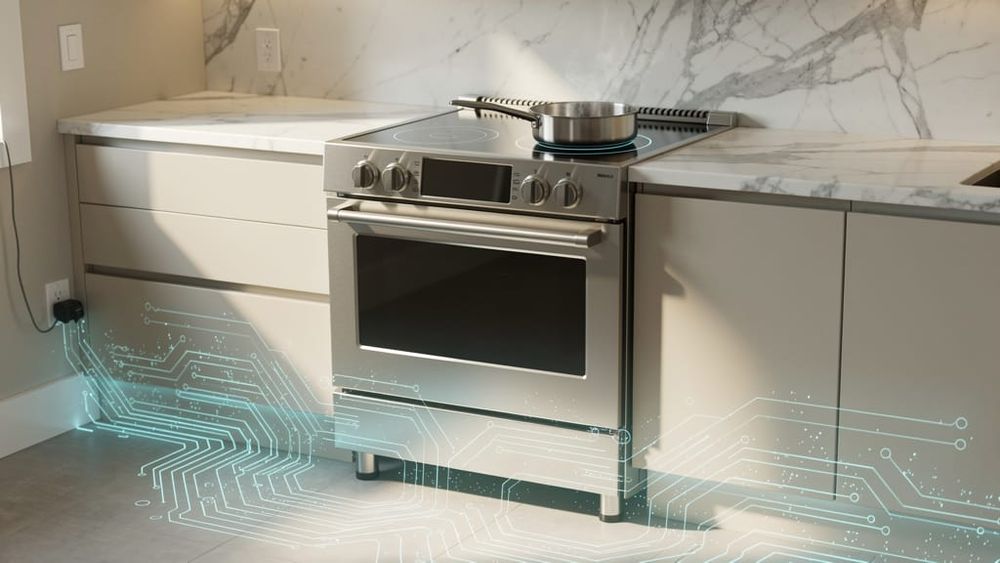
An induction range normally needs a 240-volt, 40 or 50 amp circuit, which is why swapping a gas stove for one often turns into an electrical project. A company called Copper builds a range that plugs into an ordinary 120-volt outlet instead, and it does it by putting a battery inside the appliance.
How a Battery Solves a Wiring Problem
The trick is decoupling how fast the range draws power from how fast it uses it. Cooking is bursty. A range pulls heavy power for the twenty minutes something is searing and almost nothing for the rest of the day.
Copper's range, called Charlie, holds 5 kWh of storage and draws only 120 volts at 12 amps from the wall, which any standard kitchen outlet supplies. Between meals the battery refills slowly. During cooking the four induction zones pull from the battery at up to 2.8 kW each, which is normal induction performance, not a compromised version of it. The oven is 4.55 cubic feet and runs from 80 to 550 degrees. It lists at $5,999, and because there is no circuit to run, installation is roughly an hour rather than an electrician's day.
The side effect is the interesting part for anyone thinking about resilience. Because the energy is already stored in the appliance, the range keeps working when the grid does not. Copper puts the figure at three to five meals of cooking on the onboard charge. That is a small backup system that happens to look like a stove, and unlike a generator it needs no fuel, no permit, and no place to put it.
The honest limits are worth stating. The battery carries a five-year warranty against the range's two years, which is a shorter horizon than a wall-mounted home battery. Full-service installation is limited to selected zip codes, so availability depends on where you live. And $5,999 is a premium price for a range, though it compares differently once you price in the panel and circuit work a conventional induction range would require in an older house.
The Hardware Stack:
Copper Charlie: A 30-inch induction range with 5 kWh of onboard storage that runs on a standard 120-volt, 12-amp outlet and keeps cooking during an outage.
Impulse Cooktop: A battery-equipped induction cooktop built on the same idea, for kitchens where the oven is staying put.
Tesla Powerwall 3: The conventional alternative, backing the whole kitchen circuit rather than one appliance, at a different scale and price.
Vulnerability Score
Panel capacity: A home without spare capacity in the service panel cannot add a conventional induction range without load management or a service upgrade.
Cold kitchen: A house with an electric range and no storage loses the ability to cook the moment the line goes down, whatever is in the pantry.
Fuel dependence: A gas range keeps working in an outage but ties the kitchen to a combustion appliance and its venting, which is a different tradeoff rather than a solved problem.
Where This Fits
This is not a replacement for a home battery. Five kilowatt-hours dedicated to one appliance will not run a well pump or a furnace fan, and nobody should buy it expecting that.
What it is, is a neat demonstration of a principle worth borrowing: when a circuit is the constraint, storage inside the appliance can remove the constraint without touching the panel. Water heaters and EV chargers are heading in the same direction for the same reason. If you are looking at an induction conversion and an electrician has quoted you a new circuit, it is worth pricing the battery-equipped version against the wiring it avoids before deciding.

Written by Mason Vance