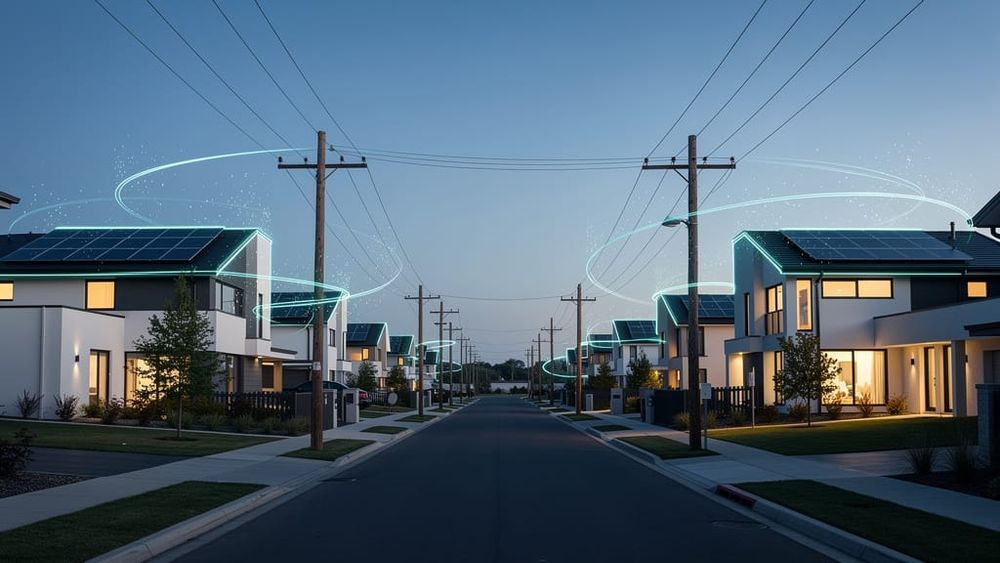
A house with solar and a battery can keep itself running during an outage. The next question is an obvious one that the grid is not currently built to answer: if a dozen houses on the same street all have batteries, why can none of them help the house in the middle that does not?
Sponsored by GoldenPortfolio
Top rated gold analyst releasing a rare buy alert
Dear Reader,
I've been a gold analyst for 20 years.
My biggest gains include an 8,400% win on a company called Silvercrest.
My research also includes a 2,000% gain on Montage and a 1,000%+ gain on G2 Goldfields - both closed out in just the past few months.
Today I've put together a new report on a very unique, high yielding gold security unlike anything else I've ever found.
The only caveat: the price is already starting to move - and the longer you wait, the smaller your yield is likely to be.
Click here to see the details before it's too late.
Best,
Garrett Goggin, CFA, CMT
Lead Analyst and Founder, Golden Portfolio
P.S. I'm so excited about this stock, I'm making the name available to anyone who wants it… No need to buy a costly research service on an annual subscription.
What a Neighborhood Microgrid Would Require
The concept is straightforward to describe and difficult to build. A section of distribution circuit disconnects from the rest of the grid during an outage and runs on the generation inside it, sharing across the houses on that section rather than keeping each one isolated behind its own meter.
Several pieces have to exist for that to work. There has to be switchgear at the substation or along the circuit capable of cleanly separating that section and holding the separation. There usually has to be storage at the circuit level, not only in the houses, because restarting a de-energized section needs a source stable enough to establish voltage and frequency before anything else can synchronize to it. The distribution boundaries have to be drawn so that energy can legally and physically move between customers. And equipment from different manufacturers has to interoperate, because the batteries on a real street will not all be the same brand.
The obstacles are not mainly technical. Utilities coordinate and operate distribution systems, and a section that can island is a section they have to be able to see, control, and restore safely with crews working on it. Selling energy across a meter boundary raises regulatory questions that vary by state. And the business model for an asset paid for by one homeowner and used by a neighbor has no settled answer.
What exists today is pilots rather than a product. Residential-scale community microgrids are being funded and built in places with a strong outage motivation, particularly where wildfire-related shutoffs are routine, and the useful posture for a homeowner is to know the concept exists rather than to wait for it.
The Hardware Stack
- Tesla Powerwall 3: A grid-forming home battery, meaning it can establish voltage on its own rather than needing an existing grid to follow.
- Enphase IQ8 Microinverters: Microinverters capable of forming a grid at the house level, which is the same capability a shared island depends on.
- SPAN Smart Panel: Circuit-level control, which is how a household would participate in a shared arrangement without giving up control of its own loads.
Vulnerability Score
Isolated resources: Today a battery next door is unavailable to you during an outage regardless of how much capacity it has, because each house islands separately.
Circuit-level dependency: A shared island still depends on utility-owned switchgear and coordination, so individual equipment alone cannot produce it.
Uneven access: Households without solar or storage gain nothing from neighbors' equipment under current rules, which concentrates resilience rather than spreading it.
What This Means for a Purchase Today
Nothing about this should change a decision to buy a battery now. What it can reasonably influence is which equipment you choose. Grid-forming capability, open standards, and the ability to participate in utility programs are features that cost little today and are the prerequisites for whatever shared arrangements eventually arrive.
The more immediate version of the same idea is already available in many territories and works through the market rather than the wires: a utility program that pays for access to your battery at peak times. It is not a neighborhood island, but it is the same underlying observation, which is that a street full of batteries is a resource and currently behaves like a street full of separate islands.
Written by Mason Vance
Two ways to play it, inside (Sponsored by Omnia Research)
Could this Strange “Golden Tablet” Secure Your Retirement? (Sponsored by Brownstone Research)
Your Next 40,000% Investment (Sponsored by Green Coffee Company)
A warning about the coming AI “White Swan” (Sponsored by Chaikin Analytics)
Elon’s 100X AI Stock (Sponsored by Behind the Markets)
Forget SpaceX, this is Elon’s Next Breakthrough (Sponsored by Brownstone Research)
Any discussion of securities, assets, or financial markets in this email is for informational context only and does not represent investment guidance of any kind.