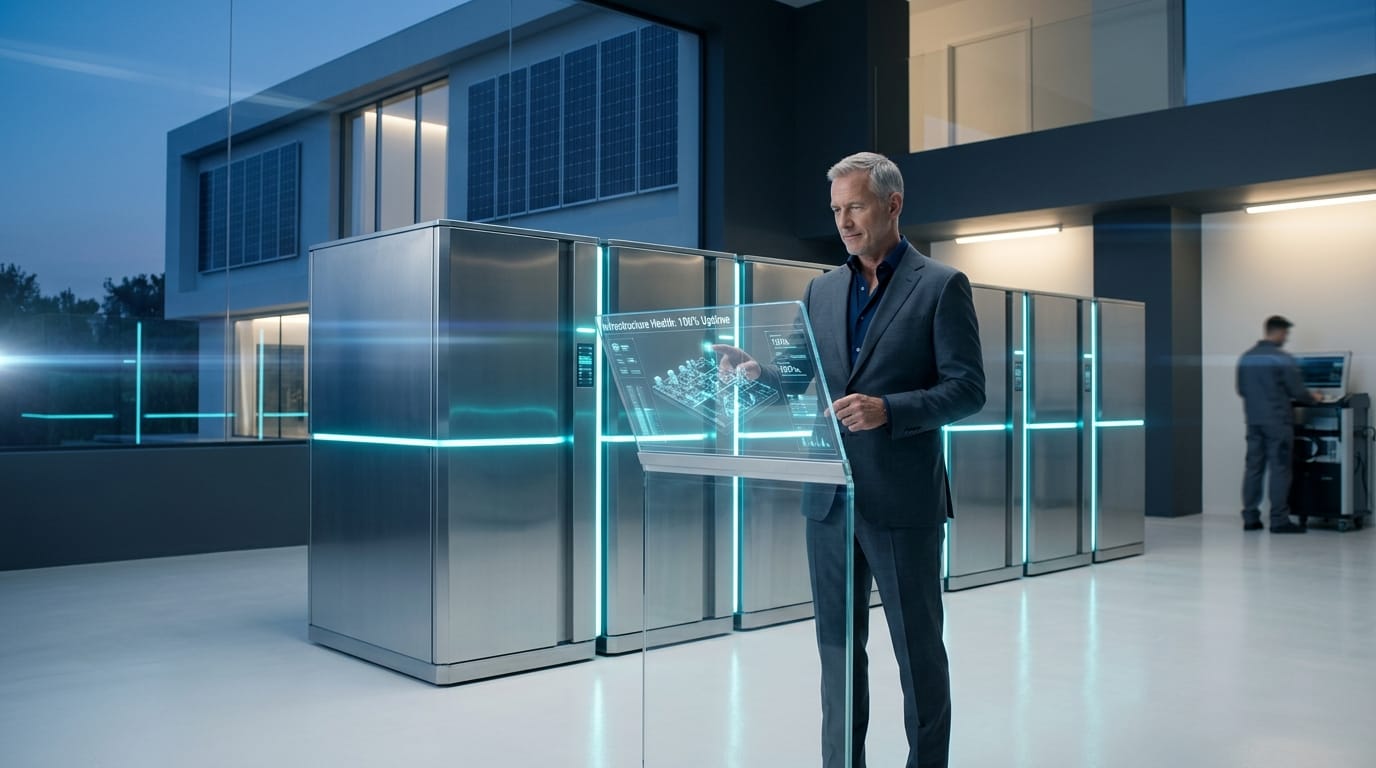

Aging transmission infrastructure and surging industrial power demand are creating grid conditions that most family estates are not equipped to handle. Building a private energy reserve on your own property is no longer a luxury consideration - it is a practical infrastructure decision.
The Great Grid Bottleneck: Insulating Your Estate From Municipal Disruption
Federal regulators are managing an unprecedented surge in national power demand against a transmission network that was not built for it. Substantial public funding has been directed at utility upgrades, but bureaucratic delays and permitting backlogs keep major projects stalled in administrative queues. Data centers with industrial-scale power requirements are connecting to regional grids faster than new capacity can be brought online. The result is a network operating under sustained strain, with copper shortages and transformer lead times compounding the physical constraints. Paper wealth cannot substitute for physical infrastructure, and the gap between what the public grid can reliably deliver and what a well-run family estate actually requires is worth examining directly.
Understanding the Structural Exposure
The transmission bottleneck is not a localized anomaly. Grid operators across multiple regions are managing demand growth that outpaces both generation additions and the interconnection capacity needed to move power where it is needed. New power projects face connection wait times measured in years, not months, because the physical infrastructure required to integrate them does not yet exist. That queue is long and growing.
For a family estate, the practical consequence of this structural condition is straightforward. Extended outages that once would have been rare are becoming a more plausible planning scenario in areas with aging distribution infrastructure or nearby high industrial load growth. Climate control, water systems, security perimeters, and communications all depend on uninterrupted power. A strong investment portfolio provides no operational continuity when the municipal lines go dark.
Vulnerability Score - a standard estate without private generation faces exposure across several critical points:
- Grid dependency: full reliance on municipal supply with no backup during extended outages
- Uptime gap: security and climate systems fail within hours of a blackout without storage
- Water access: pump-dependent water systems go offline when grid power is unavailable
- Communication continuity: network and security monitoring require sustained low-voltage power that standard backup generators may not cleanly support
- Lead time risk: generator and storage equipment procurement windows have extended considerably, meaning decisions made late provide no near-term protection.
The Reserve Vault: Engineering System Isolation
Achieving meaningful independence from municipal supply requires building a layered private energy system rather than simply adding a standby generator. The architecture that serious estate operators are deploying centers on three integrated components.
- Generac heavy-duty multi-fuel standby systems: primary generation capable of continuous off-grid operation across extended outage windows, with multi-fuel flexibility reducing dependence on any single supply source.
- Tesla Powerwall industrial-grade storage arrays: the Reserve Vault layer that captures and holds energy on-site, ensuring seamless load transition when municipal supply drops without waiting for a generator to cycle up.
- Ubiquiti smart monitoring hubs: localized command and monitoring logic that maintains security communications and system visibility independent of external network infrastructure.
Each component serves a distinct function in the overall system, and integration between them determines whether the estate experiences a seamless transition or a gap. The public grid remains vulnerable to severe weather, sudden demand spikes, and the cascading effects of upstream transmission failures. When municipal lines go dark, a properly integrated private microgrid seamlessly absorbs the load.
Preserving the Estate Through Hard Assets
The broader shift among estate owners who have carefully considered infrastructure resilience is a reallocation of capital toward physical systems with long operational lifespans and a direct protective function. Industrial-grade solar generation, robust water filtration independent of municipal supply, and integrated storage capacity are the categories attracting serious attention. These are not speculative positions. They are physical assets that perform a defined function regardless of what public utility networks are doing.
The accumulation of this kind of physical infrastructure represents a fundamentally different approach to estate preservation than portfolio management alone. Markets move, valuations shift, and paper positions require external systems to function. A properly hardened estate with private generation, storage, and water access operates on its own terms. That physical independence is what serious estate architects are building toward - a foundation that will serve the property across decades of grid uncertainty rather than waiting for municipal systems to solve a problem they have been slow to address.