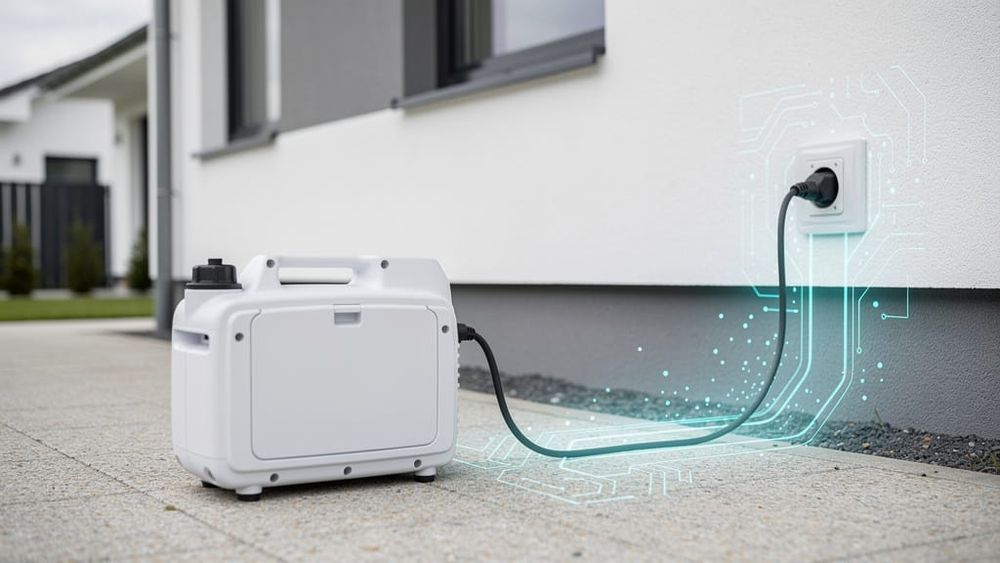
Two portable generators can look identical, carry the same wattage rating, and behave completely differently the moment you plug one into a house. The difference is whether the neutral conductor is bonded to the frame, and it is the detail most likely to send a homeowner back to the store during an outage.
Bonded, Floating, and Why It Matters
Inside a bonded neutral generator, the neutral is connected to the metal frame. This is standard on contractor-style units built for jobsite use, where the generator is the only source of power and the bond is what lets fault current find a path and trip protection.
In a floating neutral generator, the neutral and the frame are not connected. This is common on inverter generators built to feed a house, because the house already has its own neutral-to-ground bond at the main panel, and a second bond creates a parallel path that the system was never designed to have.
The mismatch shows up as a symptom that looks like a broken generator. A GFCI outlet detects an imbalance between the conductors carrying current out and back. Connect a bonded neutral generator to transfer equipment that does not switch the neutral, and the GFCI sees current returning by an unexpected route and trips, even though nothing is actually faulty. People conclude the generator is bad, or the transfer switch is bad, and neither is.
What decides the right answer is the transfer equipment. Some transfer switches switch the neutral along with the hot conductors, and those work with a bonded generator. Others do not switch the neutral, and those need a floating neutral source. The generator, the transfer equipment, the GFCI protection and the house have to be compatible as a set.
There is no reliable way to tell by looking. Two models from the same manufacturer can differ internally, so the answer is in the owner's manual, which will use phrases like floating neutral or neutral bonded to frame, usually alongside a note about transfer switch compatibility.
The Hardware Stack:
Honda EU7000iS: An inverter generator supplied with a floating neutral, intended to feed a house through transfer equipment rather than to stand alone.
Generac 6853 Transfer Switch: A manual transfer switch for portable generators, whose documentation states whether it switches the neutral, which is the fact that decides compatibility.
Reliance Controls Interlock Kit: A panel interlock as the alternative to a transfer switch, where the neutral stays connected and the generator's bonding needs to match accordingly.
Vulnerability Score
Wrong pairing: A generator whose bonding does not match the transfer equipment either trips GFCI protection on every attempt or leaves the system without the fault path it needs.
Improvised fixes: Defeating a GFCI or adding a bonding plug to silence the symptom removes protection the installation depends on, which is the wrong trade during a wet-weather outage.
Discovered during the outage: A compatibility problem found at 2 a.m. in the rain has no good solutions available, which is the entire argument for testing the setup in advance.
The Afternoon That Prevents This
The way to settle it is to run the whole setup once, on a clear day, before the season. Start the generator, connect it the way you intend to during an outage, transfer the load, and see whether the house runs and whether anything trips.
Before that, read the two documents that answer the question on paper: the generator manual's statement about the neutral, and the transfer switch or interlock documentation's statement about whether it switches the neutral. If those two do not agree, the fix is a different generator or different transfer equipment, and both are far easier to arrange in September than during the first storm.
Written by Mason Vance