Installing a home EV charger used to come with an unwelcome surprise for a lot of homeowners: a quote for a full electrical panel upgrade, often costing thousands of dollars, just to free up enough capacity for the charger to run safely alongside everything else in the house.
Why Panels Ran Out of Room in the First Place
A standard electrical panel is built with a fixed total capacity, and every circuit added to a home, air conditioning, an electric range, a water heater, chips away at how much is left. A Level 2 EV charger is one of the largest single loads a home can add, often pulling as much power on its own as several major appliances combined. For older homes, especially ones already running close to their panel's rated limit, adding a charger without upgrading the panel risked tripping breakers or exceeding safe capacity.
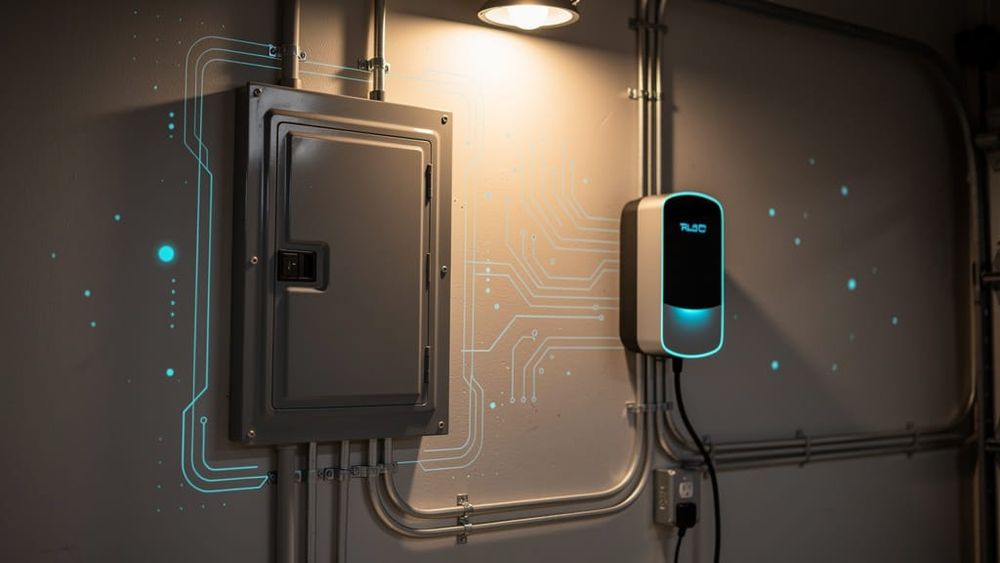
That's what load management chargers are built to solve, without touching the panel itself. Instead of drawing a fixed amount of power regardless of what else is happening in the house, these chargers monitor the home's total electricity use in real time and automatically scale the charging rate up or down to stay within the panel's existing capacity. If the air conditioning and the oven are both running, the charger backs off. When demand drops, it speeds back up.
The result is a charger that can be installed on an existing panel that technically doesn't have the theoretical headroom for it, because the system is managing actual demand rather than assuming everything might run at full power at once, which is rarely how a household actually uses electricity.
The Hardware Stack:
Emporia Pro: A Level 2 EV charger with built-in PowerSmart load management that dynamically limits charging speed to stay within a home's existing panel capacity.
SPAN Drive: A load-managing EV charger built by the same company behind the SPAN smart panel, designed to integrate directly with circuit-level home monitoring.
Wallbox: A Level 2 charger line offering power-sharing and load management features aimed at avoiding panel upgrades in supported installations.
Presented by Brownstone Research
One last chance to cash in on the AI boom
Editor’s Note: Jeff Brown and Marc Chaikin, two investment legends who picked Nvidia 10 years ago, are predicting that by the end of this month, Elon Musk’s new AI breakthrough will collide with a strange market pattern with a flawless 100% track record of massive market gains. Click here to see the details or read more below because the last time this happened everyday folks had a chance to turn $10,000 into as much as $350,000 in just about 12 months.
Dear Reader,
If you missed Nvidia when I first recommended it back in 2016, before shares jumped as high as 36,000%...
I have good news.
Elon Musk is creating a second and perhaps last chance for you to profit from this AI boom.
You see, I believe by the end of this month…
Elon’s new AI breakthrough (click here to see his patent) will collide…
With a powerful market prophecy that’s been unbroken for generations…
One that has correctly predicted some of the biggest market booms going back to 1950.
And the collision of these two economic forces…
Will give Americans a rare and perhaps last chance to turn a small stake into potentially…
An entire six-figure nest egg in the next 12-18 months.
If that sounds too good to be true…
You should know the last time these two rare economic forces collided…
Investors had a chance to turn a small stake of $10,000 into as much as $366,000 in just 14 months.
But this new retirement window won’t remain open for much longer.
The Wall Street Journal even recently warned Americans that AI advancements like this could be…
“The last chance to amass generational wealth.”
So click here now because if you miss this window…
You’ll probably never see an explosive opportunity like this again in your lifetime.
We have so much to look forward to,
Jeff Brown
Founder & CEO, Brownstone Research
Vulnerability Score
No real-time visibility: A standard, non-managed EV charger has no awareness of what else the home is drawing at any given moment, so it simply pulls its full rated power regardless of total demand.
No margin for growth: A panel already near capacity leaves little room for adding a charger, a heat pump, or other major appliances later without a full upgrade.
No avoided cost: Skipping load management and going straight to a panel upgrade can mean spending thousands more than a managed charger alone would have cost.
Deciding Whether a Panel Upgrade Is Actually Necessary
None of this means a panel upgrade is never the right call. Some homes are close enough to their limit, or planning enough additional electric appliances, that upgrading the panel is still the more durable long-term choice. But for a lot of households, a load-managing charger is a legitimate way to add EV charging now without a bigger electrical project.
The practical first step is finding out what a home's panel is actually working with today, since that's the number that determines whether load management is a real option or whether an upgrade is genuinely unavoidable.
AI just crossed a critical threshold (Sponsored by Porter & Co.)
Combined $100 billion market cap. Obsolete in 12 months. (Sponsored by Porter & Co.)