
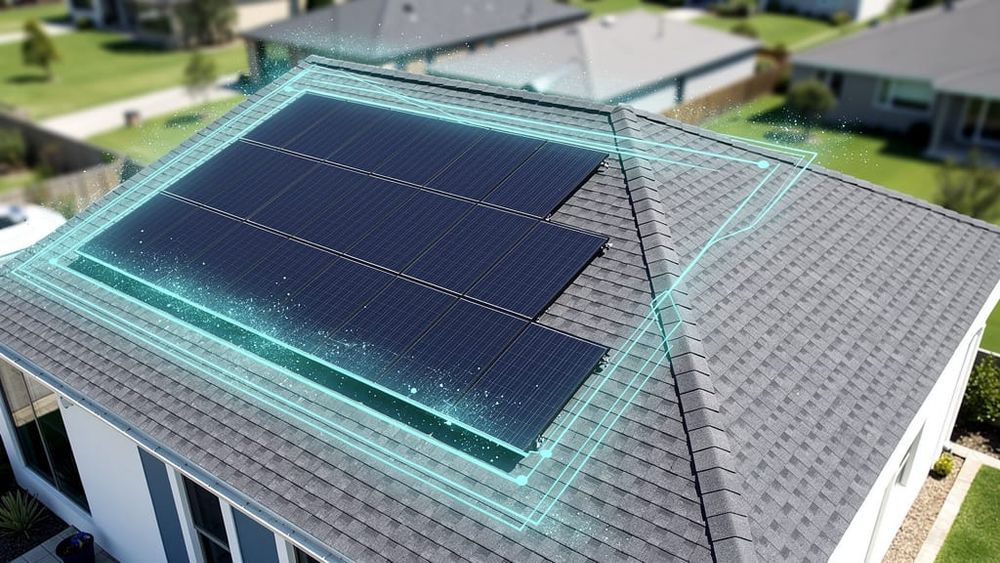
Look at enough rooftop solar and you start noticing a pattern: a bare band along the top of the roof, and sometimes a clear lane running up one side. That empty space is not a design choice or a shading allowance. It is required, and it is there for people carrying tools.
Sponsored by Behind the Markets
This has happened 3 times. you're in the 4th.
Dear Reader,
In 1790, a machine walked into a mill and did the work of 100 people.
Those 100 workers did not keep their wages.
The money moved. Straight into the pocket of the man who owned the machine.
It has happened three times since.
The factory worker. The office clerk. Then the computer took the rest.
Same story every time. The worker loses. The machine's owner gets rich.
It's happening a fourth time right now. And this time the machine is coming for the desk jobs. The good ones.
Maybe yours.
Dylan Jovine found the one company that owns the machine this time.
You can be the worker it replaces. Or the investor who owns it.
See who owns the machine, free >>
"The Buck Stops Here,"
Kelly Maguire
Behind the Markets
Why a Firefighter Shapes Your Array
When a fire is burning inside a house, one of the first things a crew does is cut a hole in the roof to let heat and smoke out. That operation needs somewhere to stand and somewhere to cut, and a roof covered edge to edge in glass and aluminium offers neither.
The fire code answers this with two kinds of clear space. The first is a setback below the ridge, commonly three feet, leaving the peak of the roof available for ventilation. The second is an access pathway, also commonly three feet wide, running from the eave to the ridge so a crew can move across the roof without walking on modules.
The details vary by code edition and by local amendment, and the variations matter. Some configurations allow a pair of narrower setbacks on either side of the ridge instead of one wide one. Hip roofs can require pathways along the hips as well. And there is a significant exception for one and two family homes: where the array does not cover the whole roof and the slope is shallow enough, pathways and ridge setbacks may not be required at all, on the reasoning that the crew can work from the uncovered portion.
The practical consequence arrives at the design stage. A homeowner sizing a system by looking at the roof and dividing by panel area will always arrive at a bigger number than the installer does. The gap between those two numbers is mostly code clearance, and it is not negotiable in the way a shading estimate is.
It is also the reason a seemingly odd layout is sometimes the right one. An array pushed to one side of a roof plane, or split across two planes, is often an attempt to preserve a pathway rather than a sign of sloppy design.
The Hardware Stack:
IronRidge XR Rail: A racking platform whose layout tools lay out arrays against pathway and setback constraints rather than simple roof area.
Enphase IQ8 Microinverters: Per-module electronics, which make an irregular array shaped around pathways perform better than a string layout would.
Unirac SolarMount: Another rail system, relevant because attachment spacing has to be re-solved whenever a code clearance moves a row.
Vulnerability Score
Expectation gap: A roof that looks large enough often is not once setbacks and pathways are removed, and the shortfall usually appears after a homeowner has already set an expectation.
Local variation: The applicable code edition and any local amendment are decided by the authority having jurisdiction, so two neighbouring towns can require noticeably different layouts.
Retrofit friction: Adding modules to an existing array later runs into the same clearances, so a roof that was filled to the code limit has no room left for expansion.
What to Ask When the Design Arrives
Ask the installer to point out the required setbacks and pathways on the layout drawing, and to say which code edition the local authority has adopted. A design that shows them explicitly is a design that has already been checked against the rule the inspector will apply.
If the system came out smaller than you hoped, ask whether the exception for partial coverage applies to your roof, and whether a second roof plane could carry the remainder. Those two questions resolve most of the difference, and both are much easier to ask now than after the permit has been submitted.
Written by Mason Vance
Pre-IPO shares at $1.10. Up to 20% bonus. (Sponsored by Green Coffee Company)
Elon’s Most Lucrative Venture to date? (Sponsored by Behind the Markets)
Robert's question: "What are you going to do?" (Sponsored by Freedom Financial Research)
Any discussion of securities, assets, or financial markets in this email is for informational context only and does not represent investment guidance of any kind.