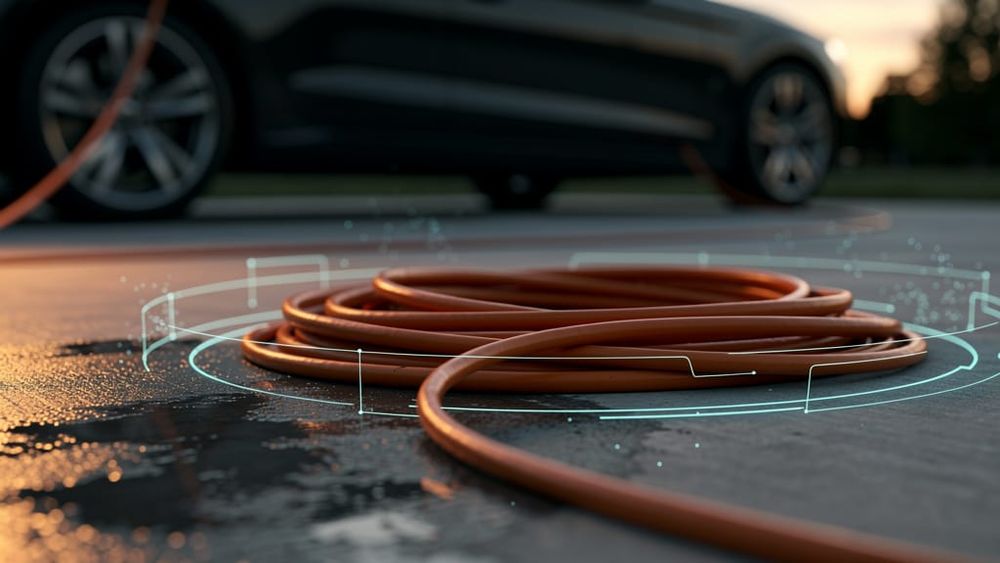

A portable generator is sized in watts, bought on watts, and discussed in watts. Then it gets connected to the house with whatever cord was in the garage, and a meaningful share of what it makes never arrives.
Sponsored by Green Coffee Company
The Next Starbucks Is Brewing in Colombia
In 1992, Starbucks went public at a split-adjusted price of approximately $0.27.
Today, its stock trades above $108.
That’s a gain of roughly 40,000%.
Put another way…
That turns $100 into $40,000…
$500 into 200,000 dollars…
And a tiny stake of $1,000 into almost half a million dollars.
But unless you invested in Starbucks back in 1992, that opportunity is already gone.
The bigger question is:
Where could coffee’s next major growth story come from?

The global coffee market is projected to reach approximately $380 billion by 2033. And its next breakout company may not be built around thousands of cafés.
It may begin with the farms…
And that’s the opportunity that could dwarf Starbucks returns.
Meet Green Coffee Company.
It owns approximately 45 Colombian farms and 10 million coffee trees.
It also holds exclusive third-party rights Juan Valdez coffee products across U.S. and Canadian retail and institutional channels.
Those products are already reaching Target, Walgreens and thousands of North American retail locations.
And individual investors can now own a stake while the company is still private.
No accreditation required.
Invest in Green Coffee Company today and own a piece of the $380B coffee market.
Why Length and Gauge Decide the Outcome
Every conductor has resistance, and resistance turns some of the voltage into heat along the way. The longer the run and the thinner the wire, the more of the supply is consumed before it reaches anything useful. Generators make this worse than ordinary house wiring does, because the generator is outdoors at a safe distance and the cord is therefore long by necessity.
The numbers are concrete. At a hundred feet carrying twelve amps on a 120 volt circuit, 14 gauge wire drops about six volts, which is roughly five percent. The same load on 12 gauge drops a little over three percent, and on 10 gauge about two. Push the load to fifteen amps and 12 gauge is already near four percent while 10 gauge stays around two and a half.
Electronics mostly shrug this off. Motors do not. A refrigerator compressor, a well pump, or a furnace blower asked to start on a sagging supply draws more current to make up the difference, and that extra current becomes heat in the windings. The same physics that makes a utility brownout hard on a compressor applies to a long thin cord, except that here the cause is entirely within your control.
There is a safety dimension as well. Anything that heats the conductor also heats the cord, and a cord run at the edge of its rating under a blanket of snow or coiled on a reel has nowhere to shed that heat. A coiled cord carrying near its limit is a genuinely bad idea.
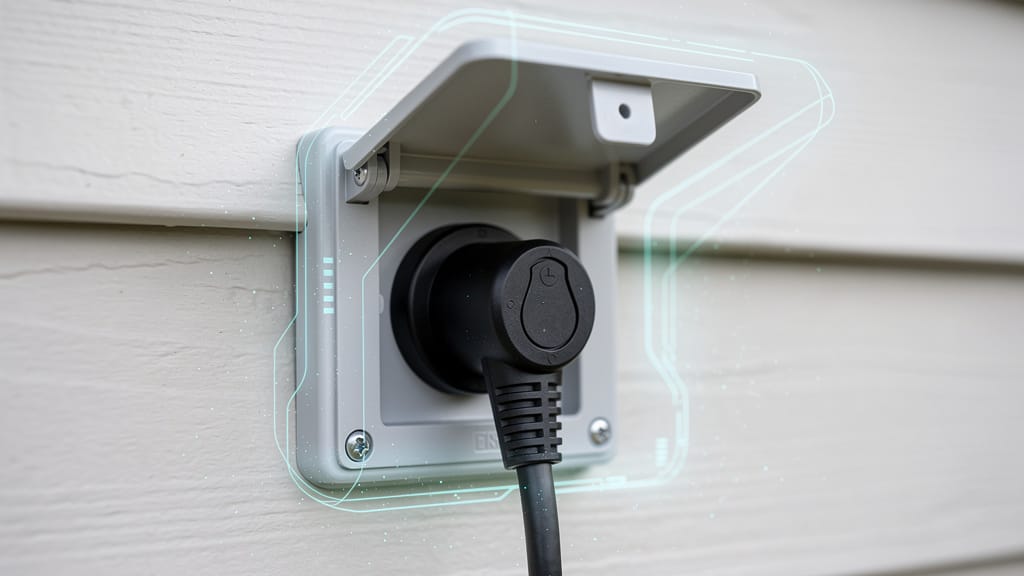
The better answer for most households is to shorten the electrical path rather than to buy a heavier cord. An inlet box mounted on the outside wall, wired to a transfer switch or a panel interlock, means one short heavy cord from the generator to the wall, and everything beyond that travels on the house's own wiring. That also removes the usual tangle of individual cords through a door that will not close.
The Hardware Stack:
Reliance Controls Power Inlet Box: An exterior inlet that terminates the generator cord at the wall, so the long run of light cords indoors disappears.
Generac 6853 Transfer Switch: A manual transfer switch for portable generators, which is what the inlet box feeds.
Southwire 10/3 Generator Cord: A heavy gauge generator cord, which is the size that keeps voltage drop near two percent over a long outdoor run.
Vulnerability Score
Lost capacity: Voltage lost in a long light cord reduces what reaches the house, so a generator sized correctly on paper underperforms in practice.
Motor stress: Compressors and pumps starting on a sagging supply draw extra current and run hot, and the damage shows up months later rather than during the outage.
Cord heat: A cord near its rating, coiled or buried in snow, cannot shed heat, and the failure mode there is not an inconvenience.
Getting This Right Before the Season
Measure the actual distance from where the generator will sit to where the power needs to arrive, remembering that the generator has to be well away from the house and clear of any opening. Then size the cord for that distance and the real load rather than the cord's own amp rating, which assumes a much shorter run.
If the plan currently involves several cords through a window, this is the year to price an inlet box and a transfer switch or interlock. It costs less than most people assume, it eliminates the voltage drop problem by making the cord short, and it turns a twenty minute improvisation in the dark into plugging in one connector and throwing one switch.
Written by Mason Vance
Invest in a Proven Hit Factory (Sponsored by Skybound Entertainment)
This is my best trading secret (Sponsored by Millionaire Publishing)
41%... 62%... 90%... 1,167%—One Washington Pattern (Sponsored by Millionaire Media)
The last cookout of summer just got a market angle (Sponsored by Millionaire Media)
Any discussion of securities, assets, or financial markets in this email is for informational context only and does not represent investment guidance of any kind.