
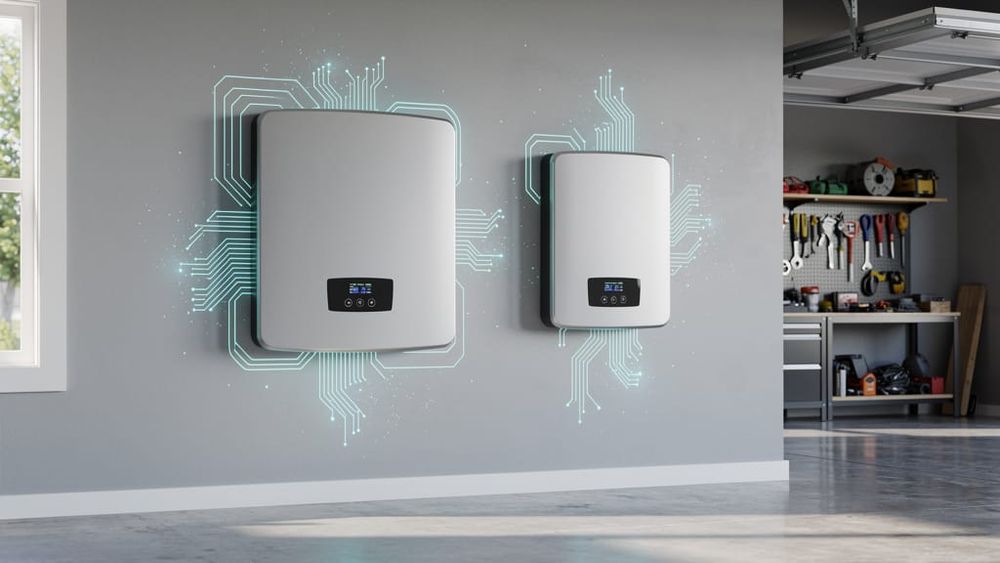
A home battery's advertised capacity and what it can actually deliver during a real outage are two different numbers, and the gap between them is where a lot of otherwise well-intentioned battery purchases go wrong. The mistake usually isn't obvious until the exact moment a homeowner is counting on the system to work.
Sponsored by Behind the Markets
1,000 new millionaires a day. And millions of victims.
Dear Friend,
The last time Washington secretly rebuilt the foundation under the dollar, it minted more than 1,000 new millionaires every single day.
For fifty years.
But the same reset destroyed the savings of millions who never saw it coming. The dollar lost 84% of its purchasing power. Hard-working families who saved carefully ended up on the wrong side of a divide they didn’t even know existed.
Not because they made bad decisions. Because nobody told them what was happening to their money.
That divide is opening again right now.
Two executive orders signed June 22. A $20 stock the government just moved to own. And a monetary shift most Americans won’t hear about until it’s too late.
Former Wall Street banker Dylan Jovine spent 8 months tracing this story. He’ll show you which side to be on.
See the $20 stock at the center of the divide >>
“The Buck Stops Here”
Kelly Maguire
Behind the Markets
Where the Math Actually Goes Wrong
The most basic sizing error is confusing watts with watt-hours, a power rating with an energy amount, which sounds technical but leads directly to a system that can't sustain a load for as long as expected even if it can technically handle that load for a moment. A second, more common mistake is sizing a battery off a utility bill's average daily usage number, which smooths over the actual peaks in consumption that matter far more during an outage than any daily average does.
The real number that matters is usable capacity, not the headline capacity printed on a spec sheet. After accounting for the battery's depth of discharge limit, round-trip efficiency losses, how temperature affects performance, and power drawn just by the inverter idling, actual usable capacity often comes in 20 to 35 percent below the advertised figure. A battery marketed at 13.5 kilowatt-hours might realistically deliver closer to 9 or 10 kilowatt-hours of usable backup power once all of that is accounted for, a difference that matters enormously when planning exactly how long a home can run on stored power alone.
The other common mistake runs in the opposite direction: sizing a system for every load a homeowner might want to run during an outage, rather than the loads that are actually necessary. Most installers recommend sizing around critical circuits, refrigeration, some lighting, communications, and perhaps a well pump or medical equipment, typically landing somewhere around 10 to 15 kilowatt-hours of usable capacity, rather than trying to power an entire home's normal draw including things like a full-size electric range or central air conditioning.
The Hardware Stack:
Tesla Powerwall 3: A home battery with a published usable capacity distinct from its total capacity, illustrating the real-world gap homeowners should account for when sizing a system.
Span Panel: A smart panel that lets a homeowner precisely define and prioritize critical circuits, directly addressing the "wanted versus needed" sizing mistake.
Enphase IQ Battery: A modular battery system that allows sizing in smaller increments, useful for matching capacity more precisely to an actual critical-load calculation.
Vulnerability Score
Sizing off average usage: A battery sized purely from a utility bill's average daily kilowatt-hour figure ignores the actual peak demand moments that determine whether backup power is sufficient.
Ignoring usable versus rated capacity: Assuming the full advertised capacity is available during an outage overstates real backup runtime by a meaningful margin.
Sizing for wants instead of needs: A system sized to run every convenience appliance in the home, rather than critical circuits specifically, often ends up either oversized and expensive or undersized against unrealistic expectations.
What This Means for Anyone Getting a Battery Quote
None of this is an argument against buying a battery, it's an argument for asking the right questions before finalizing a system size. A homeowner should ask an installer directly for the usable capacity number, not just the rated capacity, and should walk through an actual list of critical circuits rather than relying on a generic recommendation.
Getting this calculation right before installation is far easier than discovering a shortfall during an actual multi-day outage, when there's no ability to quickly add capacity to a system that turns out to be smaller than what the moment actually requires.
Written by Mason Vance
The difference between getting rich and staying broke (Sponsored by Freedom Financial Research)
While Elon tweets about UBI, these investors collect 10% a year (Sponsored by Freedom Financial Research)
Trump’s secret money reset exposed (Sponsored by Porter & Co)
This desert breakthrough could launch a new dynasty (Sponsored by Behind the Markets)
While the market is closed, this is when the real money moves (Sponsored by Millionaire Publishing)
A revolutionary new type of AI (Sponsored by Brownstone Research)